
In a significant development in international trade, the European Union (EU) and India are moving closer to finalizing a historic free-trade agreement (FTA) – Europe India Trade Deal that could reshape global commerce. This agreement is being negotiated against the backdrop of growing tensions between the EU and the United States, highlighting India’s increasing strategic and economic importance on the global stage.
The EU-India free-trade deal has been under discussion for several years, but recent diplomatic momentum suggests that both sides are now poised to formalize the agreement. Sources indicate that a formal announcement could be made in New Delhi during upcoming high-level EU-India summits. This deal, expected to cover industries, services, investments, and intellectual property rights, is being described as one of the largest trade agreements in recent history. Agriculture remains a sensitive area and may be negotiated separately.
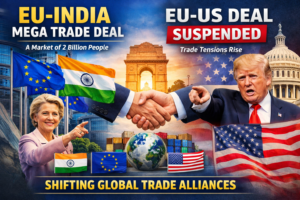
Key Highlights of the EU-India Trade Deal:
-
Population and Market Impact: The partnership would create a market encompassing nearly 2 billion people, combining India’s 1.4 billion with the EU’s 600 million residents.
-
Economic Weight: Together, India and the EU account for approximately one-quarter of global GDP, giving this deal significant international economic influence.
-
First-Mover Advantage: By finalizing the deal before other major powers act, the EU seeks to establish early commercial ties and long-term goodwill with one of the world’s fastest-growing economies.
-
Strategic Diversification: The agreement is also a strategic hedge as EU companies look to diversify trade away from over-reliance on the U.S. or China.
The urgency for Europe to deepen trade ties with India has been accentuated by recent tensions with the United States. The EU recently froze a trade deal with the U.S., citing disagreements over policies promoted by former President Donald Trump. European lawmakers delayed the ratification of an existing trade agreement in response to Trump’s controversial statements about Greenland and his tariff threats. Analysts note that these developments underscore Europe’s willingness to assert its economic sovereignty and reduce dependence on U.S. trade policy.
Meanwhile, India continues to engage with the United States on trade matters. Although a comprehensive India-U.S. trade agreement is yet to materialize, both countries remain in negotiation to address tariffs, market access, and other trade barriers. Experts suggest that any delay in U.S.-India trade agreements may further incentivize India to accelerate trade deals with the EU.
The upcoming EU-India trade deal is being watched closely for several reasons:
-
It represents a major milestone in India’s global trade strategy.
-
It reflects the EU’s commitment to diversifying partnerships amid geopolitical uncertainties.
-
It has potential implications for global trade patterns, influencing relations with the U.S., China, and other major economies.
With formal talks nearing completion, this agreement could mark a turning point in international trade relations, emphasizing India’s rising role as an indispensable partner and the EU’s strategic intent to secure long-term economic influence in Asia.
Also Read- Mahindra Targets IPO for Electric Three-Wheeler Business by 2027: CEO Anish Shah
Also Read- PhonePe Updated DRHP Filed With SEBI : Key IPO Details and Latest Financials
1 thought on “Europe India Trade Deal : Historic Deal in Progress Amid EU-US Trade Tensions”