
Global private equity major Blackstone is reportedly evaluating an initial public offering (IPO) of its portfolio company PGP Glass in India, with the proposed issue size estimated at around $500 million (₹4,150 crore). The discussions are said to be at an early stage, and the company is yet to file draft papers with the market regulator SEBI.
PGP Glass IPO discussions are being watched closely because the company operates in a niche manufacturing segment where India is seeing rising investor interest. Over the last few years, packaging companies have gained attention due to increasing demand from FMCG, liquor, cosmetics, and pharma industries. If Blackstone moves forward with this listing, it could become one of the biggest packaging-related IPOs in India and may attract both domestic and global institutional investors.
As per the report, Blackstone has initiated preliminary talks with investment banks to assess market appetite and valuation for the potential listing. If the plan progresses, the IPO could value PGP Glass at up to $4 billion (around ₹33,000 crore), though the final numbers will depend on market conditions and the structure of the issue.
The proposed IPO would be part of Blackstone’s broader strategy of monetising mature assets in India, amid a strong domestic equity market and sustained investor interest in manufacturing and export-oriented businesses.
What is PGP Glass and what does the company do?
PGP Glass, formerly known as Piramal Glass, is a global player in glass packaging solutions, catering primarily to premium and specialised segments. PGP Glass was earlier known as Piramal Glass, which belonged to the Piramal Group for decades. The company’s roots trace back to Gujarat Glass (later becoming Piramal Glass). In 2021, Blackstone acquired Piramal Glass from the Piramal Group and subsequently renamed it PGP Glass. Multiple reports pegged the transaction around $1 billion (₹8,300 crore) and noted it as a landmark deal in Indian packaging
PGP Glass is considered a premium glass packaging manufacturer because it focuses on high-end bottles rather than mass-market low-margin glass products. Its business model is strongly linked to branding-driven industries where packaging is not just a container but a key part of the product’s identity. For example, perfume bottles and luxury liquor bottles are often designed with unique shapes, thick glass quality, and decorative finishing—areas where PGP Glass has built strong capabilities.
PGP Glass focuses on manufacturing high-quality glass bottles and containers, with a strong emphasis on design, aesthetics, and value-added packaging. Its products are widely used by brands across multiple industries, including:
-
Cosmetics and perfumery, where premium glass bottles play a crucial role in brand positioning
-
Specialty spirits and beverages, including liquor and alcoholic drink packaging
-
Food packaging, such as jars and containers for processed and specialty foods
-
Pharmaceutical packaging, supplying glass containers that meet industry quality standards
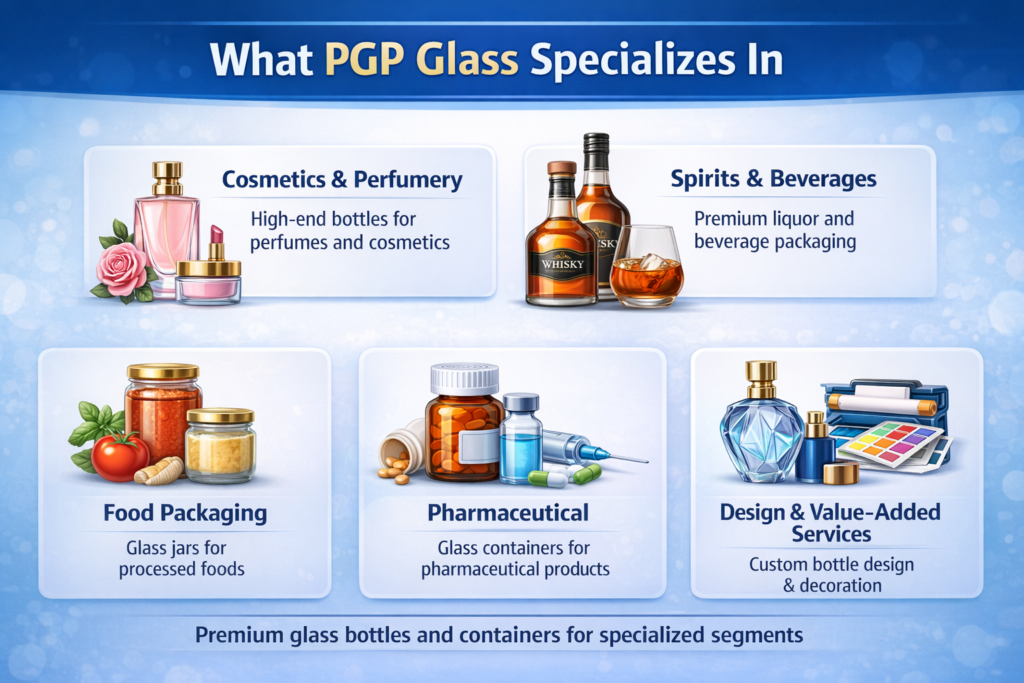
The company also provides value-added services such as bottle design engineering, mould development, surface decoration, printing, and customized finishes. This helps PGP Glass build long-term relationships with clients and earn better margins compared to standard glass packaging manufacturers. Such premiumisation is a major growth driver globally, especially in cosmetics and high-end alcohol segments where brands want packaging that stands out.
Beyond manufacturing, PGP Glass also offers design, decoration, and customization services, allowing clients to create differentiated packaging—an area that typically commands better margins compared to plain glass bottles.
Global footprint and growth focus
PGP Glass operates manufacturing facilities across India, Europe, and Latin America, enabling it to serve both domestic and international clients. The company benefits from rising demand for premium and sustainable glass packaging, as brands increasingly shift away from plastic toward recyclable materials.
With a strong export presence and diversified end markets, PGP Glass is positioned as a B2B manufacturing story that blends scale with premiumisation—one of the key reasons it is seen as a suitable IPO candidate.
Having manufacturing facilities across multiple regions also reduces dependence on any single geography and improves supply chain stability. This is important in the packaging industry because customers prefer suppliers who can deliver consistently across countries. PGP Glass benefits from a diversified customer base and export demand, which can provide stable revenues even when domestic demand slows down.
Why Blackstone May Consider This IPO
For Blackstone, an IPO could be a strategic way to monetise its investment while still retaining partial ownership. Private equity firms often list mature portfolio companies once they achieve stable operations and growth visibility. If PGP Glass gets listed at a valuation close to $4 billion (₹33,000 crore), it would represent a major value creation compared to Blackstone’s acquisition cost reported around $1 billion (₹8,300 crore).
A public listing can also improve the company’s brand credibility, allow easier access to future capital, and help PGP Glass compete more strongly in global markets.
What to watch next
At this stage, the IPO remains under evaluation, and no official timeline has been announced. Market participants will closely track:
-
Whether PGP Glass files a DRHP with SEBI
-
The issue structure (fresh issue vs offer-for-sale)
-
Any indication of a shareholder quota or anchor allocation
If executed, the listing could become one of the notable private equity–backed IPOs in India, potentially raising ₹4,150 crore and adding another global manufacturing name to Dalal Street.
Investors will also pay attention to the company’s financial performance, export contribution, and profitability margins, because glass manufacturing is energy-intensive and can be impacted by fluctuations in fuel and raw material costs. Another key factor will be whether the IPO includes a fresh issue component for growth funding, or is mainly an offer-for-sale where Blackstone partially exits.
Key Risks and Challenges
While the IPO story looks attractive, investors should also understand that glass manufacturing is a competitive and cost-sensitive business. Profit margins can be affected by energy prices, logistics costs, and demand cycles in end-user industries like liquor and cosmetics. The company will also face competition from both Indian and international packaging players.
Despite these challenges, premium packaging businesses generally enjoy better pricing power, especially when they offer design-driven and customised products.
Also read – PhonePe Updated DRHP Filed With SEBI : Key IPO Details and Latest Financials
Also Read – EAAA India Alternatives Re-Files IPO Plan | DRHP with Shareholder Quota IPO— Second Attempt After Withdrawal
2 thoughts on “Blackstone explores India – PGP Glass IPO; issue size may be around $500 million”