
Indian equities ended Friday with a clear “risk-off” tone as traders cut positions before a three-day break and a crucial derivatives expiry week. The Nifty 50 closed at 25,048.65 (down 241.25 points / -0.95%) after failing to hold early gains. The index opened at 25,344.60, hit an intraday high of 25,347.95, and slipped to a low of 25,025.30 as selling accelerated into the second half—especially in the last hour of trade.
Broad-based selling: more losers than winners
Market breadth was firmly negative, highlighting that the fall wasn’t limited to a single pocket of the market. On NSE, decliners (2,301) sharply outnumbered advancers (880), while only 78 stocks were unchanged. Stocks making 52-week lows (378) far exceeded those at 52-week highs (35)—a snapshot that reflects broader caution. Circuit activity also pointed to heightened volatility, with 98 stocks in lower circuit versus 72 in upper circuit.
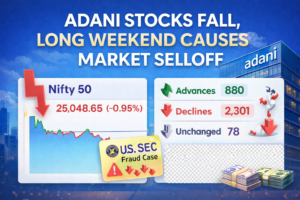
This kind of breadth typically appears when sentiment weakens across the board—where selling pressure spreads beyond index heavyweights into midcaps and smallcaps, the segments most sensitive to retail sentiment and momentum.
Why the market fell
Friday’s decline was driven less by one single headline and more by a combination of sentiment and event risk—exactly the kind of setup that often shows up before a long weekend.
Long weekend positioning: “Why carry risk when markets are shut?”
With markets heading into a three-day break, traders often reduce leverage and avoid carrying large overnight risk. The logic is simple: any unexpected global or domestic headline during the holiday can create a gap-up or gap-down at the next open, and leveraged positions are the most vulnerable. This “holiday de-risking” becomes even more visible when overall mood is already fragile.
Expiry week pressure: rollover anxiety ahead of Tuesday’s monthly expiry
Next week has monthly expiry on Tuesday, and with Monday being a holiday, the effective window to manage positions shrinks. That tends to increase last-minute activity—unwinding, hedging, or rolling positions—adding to intraday volatility. Market participants often prefer to keep exposure lighter when expiry is close, especially after a choppy week.
Foreign flows and the “sell on rise” behavior
Another visible theme in the day’s narrative was the market’s struggle to hold higher levels. In such phases, even small rallies invite selling—creating the feeling that the market “can’t stay up.” This matches what many traders describe as “sell on rise”, where any intraday bounce becomes an opportunity to reduce risk rather than add fresh longs.
The Adani shockwave: SEC move sparks sharp group-wide selling
A major contributor to Friday’s risk-off mood was the steep fall across Adani group shares after a fresh U.S. regulatory development.
According to Reuters, the U.S. Securities and Exchange Commission (SEC) asked a U.S. court for permission to bypass the Indian government and serve summons via email to Gautam Adani and Sagar Adani. The SEC’s filing said India had twice refused to serve the documents. This relates to allegations tied to an alleged $265 million bribery scheme and claims of misleading U.S. investors in connection with Adani Green Energy. The Adani group has denied the allegations as “baseless” and said it would explore legal options.
Markets reacted swiftly. Reuters reported multiple Adani companies falling 2% to 13%, with Adani Enterprises dropping as much as ~9.1% in the session.
Earnings also in focus: Adani Green turns from profit to loss
Adding to the pressure, Adani Green Energy posted a consolidated loss of ₹41 crore versus a profit of ₹492 crore in the year-ago quarter, as reported by The Economic Times. This earnings swing became another negative trigger on an already weak day for the group.
What Friday’s tape is really saying
Friday’s action wasn’t just an index dip—it was a breadth-led selloff with a clear “reduce risk” mindset. The combination of:
-
long-weekend de-risking,
-
expiry-week positioning,
-
weak overall sentiment, and
-
headline-driven selloff in a heavyweight group (Adani)
Also Read – Adani Stocks Fall Up to 9% After US SEC Pushes Fraud Case Forward – All You Need to Know
Also Read – Juspay Becomes the First Unicorn of 2026 After $50 Million Funding From WestBridge
1 thought on “Why Indian Stock Market Fell Today Ahead of the Long Weekend Selling Intensifies”