
Canada’s Economy Under Pressure from the United States
Recently, Canadian Prime Minister Mark Carney addressed the nation and warned that Canada’s economy is facing pressure from abroad. The statement came amid growing tensions with the United States after former US President Donald Trump threatened to impose 100% tariffs on Canadian goods if Canada deepens trade ties with China.
Trump accused Canada of potentially becoming a gateway for Chinese goods into the US market. In response, Carney clarified that Canada does not plan to sign a full free trade agreement with China and will continue respecting its commitments under the US-Mexico-Canada Agreement (USMCA). However, the geopolitical message was clear: Canada’s trade policies are under intense scrutiny from Washington.
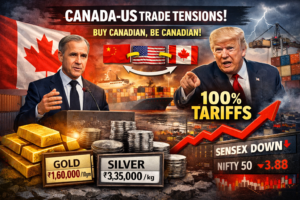
This episode highlights how deeply Canada remains dependent on the United States. More than two-thirds of Canadian exports still go to the US, making Washington’s economic pressure a powerful geopolitical tool.
“Buy Canadian” Policy and National Unity
In response to the tariff threat, the Canadian government has started promoting a “Buy Canadian” narrative. The idea is to strengthen domestic manufacturing, reduce reliance on foreign goods, and boost national economic confidence.
This strategy mirrors economic nationalism policies seen in other countries, including India’s Make in India campaign. The Canadian leadership is emphasizing unity, domestic production, and self-reliance at a time of global uncertainty.
However, experts argue that such policies have limited impact when a country is highly integrated with a dominant trading partner like the US. Canada’s geography, population distribution near the US border, and integrated supply chains make complete economic independence unrealistic in the short term.
Global Geopolitical Risk and Gold–Silver Rally
Geopolitical tensions like the Canada–US trade conflict often push investors toward safe-haven assets like gold and silver. Recently, global gold prices crossed $5,000 per ounce for the first time, driven by geopolitical uncertainty, fiscal concerns, and currency volatility.
Gold & Silver Prices in India Today (26 January 2026)
-
24K Gold: ~ ₹1,60,260 per 10 grams
-
22K Gold: ~ ₹1,46,900 per 10 grams
-
Silver: ~ ₹3,35,000 per kg
These prices remain near record highs, reflecting strong global demand for precious metals as safe assets.
Impact on Indian Stock Market and Economy
1. Risk-Off Sentiment
If US–Canada–China tensions escalate into a broader trade war, global markets could turn risk-averse. This usually leads to:
-
Stock market volatility
-
Capital moving out of equities
-
Higher demand for gold and bonds
2. Currency and Trade Impact
Trade conflicts can strengthen the US dollar, which typically weakens emerging market currencies like the Indian rupee. A weaker rupee increases India’s import bill, especially for oil and gold.
3. Opportunity for India
On the positive side, trade conflicts can create export opportunities for India. If US companies reduce dependence on China or Canada, India could attract manufacturing and supply chain diversification investments.
Key Lesson for India: Trade Diversification
The Canada case highlights a critical lesson for India:
👉 Over-dependence on one trading partner is risky.
India currently relies heavily on:
-
GCC countries for energy
-
The US and EU for exports
-
China for imports
To avoid geopolitical pressure, India needs to diversify trade with countries like France, Germany, South Korea, ASEAN nations, and Africa. A diversified trade portfolio reduces vulnerability to tariffs, sanctions, or political pressure.
Conclusion
The Canada–US tariff dispute is more than a bilateral trade issue—it is a demonstration of how economic power shapes global geopolitics. Canada’s push for domestic production and unity reflects a global trend toward economic nationalism, but structural dependence on the US remains a major constraint.
For investors, the rising gold and silver prices signal increasing global uncertainty. For India, this crisis serves as a reminder that economic independence is not about isolation, but diversification and strategic partnerships.
Also Read – Europe India Trade Deal : Historic Deal in Progress Amid EU-US Trade Tensions
Also Read- Juspay Becomes the First Unicorn of 2026 After $50 Million Funding From WestBridge
1 thought on “Canada–US Trade Tensions: What It Means for Global Markets and India”