
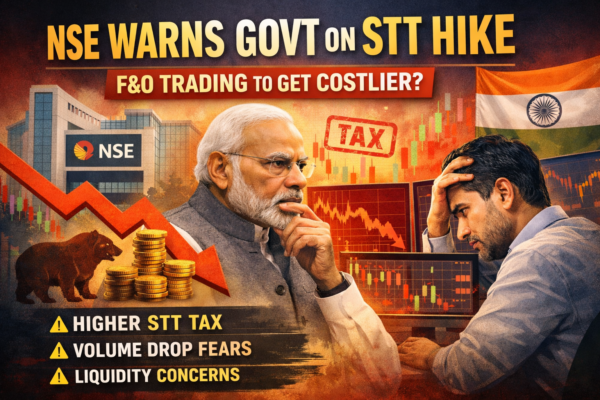
The Union Budget has introduced another major change for stock market traders, especially those active in the Futures & Options (F&O) segment. According to a LiveMint report, the National Stock Exchange (NSE) has raised concerns with the government regarding the sharp increase in Securities Transaction Tax (STT) on derivatives trading. NSE believes this hike could make trading costlier, reduce participation, and negatively impact overall market liquidity.
This development is important because India’s derivatives market is one of the largest in the world by volume, and even small changes in taxes can have a big effect on trading behaviour.
What Exactly Happened?
As per the report, NSE has highlighted to the government that the STT hike on futures and options may create additional burden on traders. The exchange is worried that the new tax structure will reduce market activity and could lower overall derivatives volumes. NSE’s point is simple: F&O trading is already heavily charged through brokerage, exchange fees, GST, stamp duty, and other transaction costs. Now, with STT increasing again, the total cost of trading becomes even higher.
NSE also indicated that derivatives trading is not only used for speculation. Many investors use futures for hedging, meaning they use derivatives to protect their long-term portfolios. If the cost of hedging increases, it could discourage genuine market participants, not just risky traders.
STT Was Already Increased in the Last Budget Too
One major reason why this Budget decision shocked traders is that STT was already hiked in the previous Budget as well. After that hike, many market participants believed the government would not increase STT again so soon.
Instead, people expected this Budget to focus more on:
-
improving transparency in F&O
-
controlling excessive speculation through regulations
-
reducing risky retail participation in weekly expiries
But the government surprised the market by increasing STT again, which has created fresh worry among traders and brokers.
Before the Budget, many traders assumed that since regulators like SEBI were already tightening rules in derivatives, the government might avoid increasing STT further. The expectation was that the focus would remain on risk control, not on increasing transaction taxes.
However, what happened was the opposite. STT was increased again, making it clear that the government wants to either discourage excessive derivatives activity or increase revenue collection from this high-volume segment.
How Will This STT Hike Impact Traders?
The biggest impact will be seen in options trading, where retail participation is huge. Most retail traders trade in weekly expiry options because they look cheap and provide fast movement. But in reality, options are highly risky and most retail traders lose money.
With higher STT:
-
Trading will become more expensive
-
The break-even point will increase (you need more profit just to cover charges)
-
Small traders may reduce the number of trades
-
Intraday scalping strategies may become less profitable
In simple words, traders who do 10–20 trades daily will feel the biggest impact.
NSE’s Key Concern: Liquidity and Volume May Fall
NSE’s main worry is that higher STT could reduce derivatives volumes, and lower volumes mean lower liquidity. Liquidity is important because it helps traders get fair prices and smooth execution.
If liquidity falls:
-
bid-ask spread may increase
-
option pricing may become less efficient
-
hedging becomes harder
-
market volatility can increase
That is why NSE wants the government to reconsider or review the STT hike after seeing its impact.
Why Government is Doing This?
This STT hike is not happening alone. Over the last 1–2 years, regulators have been tightening the derivatives market because retail participation has grown massively and speculation has increased.
SEBI has repeatedly mentioned that most retail traders lose money in options trading. Because of this, the government and regulators have been taking steps to reduce the “gambling style” trading environment.
Other Major Derivatives Regulations in Recent Times
Bank Nifty Weekly Expiry Restriction
Earlier, Bank Nifty weekly expiry attracted huge volumes. But regulators later pushed for restrictions because weekly expiry was encouraging aggressive short-term speculation. The market saw changes where weekly expiry structure became tighter.
Multiple Expiry Restrictions
Earlier, multiple indices had too many weekly expiries, which increased speculation. Regulators forced exchanges to limit excessive expiries, so that derivatives trading becomes more disciplined and less addictive for retail traders.
Jane Street Case
The Jane Street matter became widely discussed because it raised concerns about whether big institutions with advanced trading systems could take unfair advantage in derivatives markets. While details are technical, the key point is that such cases increased regulator attention on:
-
market manipulation concerns
-
high-frequency trading influence
-
unfair advantage in derivatives pricing
This is another reason why the government and regulators are focusing more on controlling derivatives trading and reducing excessive volume.
The latest STT hike on futures and options is a clear sign that the government wants to tighten the F&O ecosystem. While it may increase tax revenue, it can also reduce liquidity and make trading expensive for retail and institutional participants. NSE has raised concerns because derivatives are not just speculation tools — they are also important for hedging and risk management.
With the government already restricting weekly expiries, reducing multiple expiries, and regulators keeping an eye on market structure issues like the Jane Street case, it is clear that India’s derivatives market is entering a phase of higher cost and stricter regulation.
Also Read – SBI Mutual Fund IPO Timeline: DRHP Soon, Listing Likely by September 2026
Also Read – PNGS Reva Diamond Jewellery IPO May Launch Soon: SEBI Approval Done, Will PN Gadgil Shareholders Get Quota?