
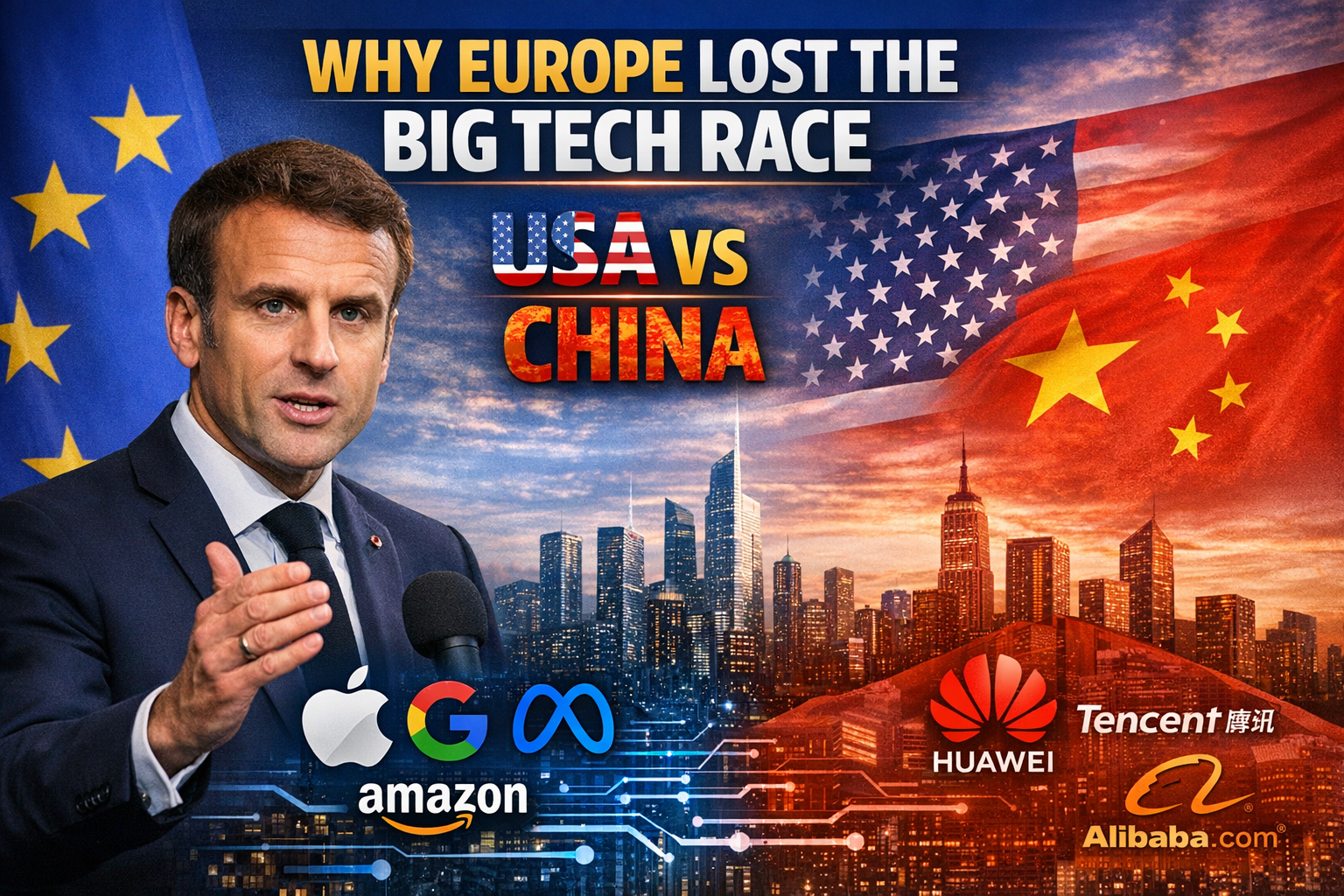
In a powerful and unusually candid conversation on a recent podcast with Raj Shamani, the President of France, Emmanuel Macron, addressed a question that many founders, economists, and policymakers have been quietly asking for years:
If Europe invented so many foundational technologies, why are the world’s largest technology companies today American or Chinese?
His answer was remarkably direct.
“Scale. Capital. And appetite for risk.”
That three-part response reveals a structural story — not just about France, but about Europe’s place in the modern technology race.
This article breaks down Macron’s argument in depth, examines Europe’s innovation paradox, and explores what founders and policymakers around the world can learn from it.
Who Is Emmanuel Macron And Why His View Matters
Before diving into the analysis, it’s important to understand who is making this argument.
Emmanuel Macron has served as the President of France since 2017. He became the youngest president in French history at age 39. Prior to politics, he worked in investment banking and later served as France’s Minister of Economy.
Unlike many traditional European politicians, Macron has positioned himself as:
-
Pro-innovation
-
Pro-startup
-
Pro-European integration
-
Focused on technological sovereignty
He launched initiatives like “Choose France” to attract global investment and pushed for a stronger, more unified European tech ecosystem.
When he speaks about Europe’s structural weaknesses in tech, he does so not as an academic observer — but as a policymaker attempting to fix the system.
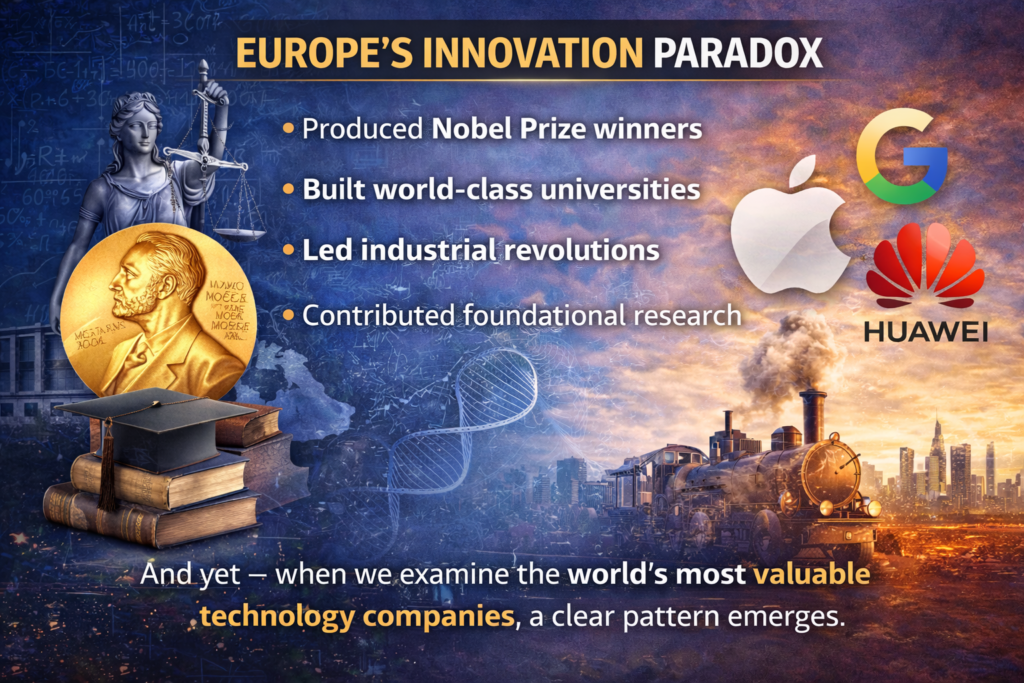
Europe’s Innovation Paradox
Europe is not short of intelligence or scientific legacy.
Historically, European countries have:
-
Produced Nobel Prize winners in physics, chemistry, and economics
-
Built world-class universities
-
Led early industrial revolutions
-
Contributed foundational research in computing, mathematics, and engineering
Even the word “entrepreneur” originates from French.
And yet — when we examine the world’s most valuable technology companies, a clear pattern emerges.
Global Tech Power Comparison
| Region | Tech Giants | Market Structure | Dominant Advantage |
|---|---|---|---|
| United States | Apple, Microsoft, Google, Amazon, Meta | Unified national market | Deep venture capital + network effects |
| China | Tencent, Alibaba, ByteDance | Centralized scaling | State-backed industrial strategy |
| Europe | SAP, ASML, Spotify | Fragmented by country | Strong research but limited hyperscale |
| India | Emerging digital ecosystem | Massive population scale | Digital public infrastructure |
Europe has strong niche champions — but not hyperscale consumer tech giants.
Why?
The Scale Problem: Fragmentation Slows Growth
Macron emphasized that Europe’s biggest structural issue is scale.
Although the European Union has over 450 million people, startups do not operate in a frictionless environment.
In practice, companies face:
-
Different tax regimes
-
Different labor laws
-
Different regulatory systems
-
Multiple languages
-
Varied compliance requirements
A French startup expanding to Germany or Italy still encounters legal and operational friction.
By contrast:
United States
-
One language
-
One primary regulatory structure
-
One financial market
-
One unified consumer base of 330+ million
China
-
Centralized governance
-
Coordinated industrial policy
-
Rapid scaling across a single controlled system
In digital markets, scale determines survival.
Network effects mean:
-
The first company to dominate often wins globally.
-
User base compounds advantage.
-
Data scale improves AI capabilities.
Europe’s fragmentation slows this exponential compounding.
Macron admitted Europe must strengthen its single market — not just politically, but practically.
Capital Allocation: Money Exists, But It Flows Differently
One of Macron’s most striking points was this:
Europe has enormous savings — even more than the United States.
The issue is not lack of money.
The issue is where that money goes.
Capital Deployment Comparison
| Factor | United States | Europe |
|---|---|---|
| Venture Capital Depth | Extremely high | Moderate |
| Pension Fund Tech Investment | Aggressive | Conservative |
| IPO Ecosystem | NASDAQ global magnet | Fragmented exchanges |
| Banking Structure | Market-driven | Regulation-heavy |
| Risk Tolerance | High | Cautious |
In Europe:
-
Banks are heavily regulated.
-
Insurance funds prioritize bonds.
-
Institutional capital prefers stability.
In the United States:
-
Pension funds invest in venture capital.
-
Loss-making startups receive funding for years.
-
Deep tech experiments get long-term backing.
This structural capital difference explains why Silicon Valley could sustain:
-
Years of unprofitability
-
Massive R&D spending
-
Moonshot ventures
Europe’s financial system evolved to preserve stability — not to fuel hypergrowth.
Risk Appetite: The Cultural Variable
Macron openly stated that Europe needs “more appetite for risk.”
This is perhaps the most difficult issue to reform.
European economies are built around:
-
Strong worker protections
-
Social welfare guarantees
-
Stable career pathways
Failure in business can carry social stigma.
In Silicon Valley:
-
Failure is normalized.
-
Founders often fail multiple times before success.
-
Bankruptcy does not permanently damage reputation.
Macron highlighted a critical truth:
Innovation requires accepting multiple failures before achieving one breakthrough.
In AI, biotech, and quantum computing, failure is statistically inevitable.
If a society penalizes failure too heavily, innovation slows.
The Hidden Trade-Off: Stability vs Speed
Europe’s model prioritizes:
-
Equality
-
Environmental standards
-
Labor rights
-
Regulatory oversight
These are social strengths.
But in fast-moving technology markets, speed often beats perfection.
American tech firms scaled first and regulated later.
Europe frequently regulates first and scales later.
This structural philosophy shapes outcomes.
Lessons From India’s Digital Leapfrog
Interestingly, the discussion also touched upon India’s rapid digital transformation.
India built:
-
Aadhaar
-
UPI
-
Digital identity systems
-
Scalable public digital infrastructure
Rather than replicate Western legacy systems, India leapfrogged directly to mobile-first infrastructure.
This shows that scale and political alignment can sometimes overcome historical disadvantages.
Comparative Insight
| Variable | Europe | India |
|---|---|---|
| Market Fragmentation | High | Unified digital stack |
| Digital Payment Adoption | Moderate | Explosive growth |
| Demographics | Aging | Young population |
| Risk Culture | Cautious | Rapidly growing startup ecosystem |
| Public Digital Infrastructure | Developing | Advanced DPI model |
India demonstrates that large-scale digital infrastructure can be built quickly when policy, technology, and population scale align.
The AI Race and Europe’s Response
Macron is not ignoring these weaknesses.
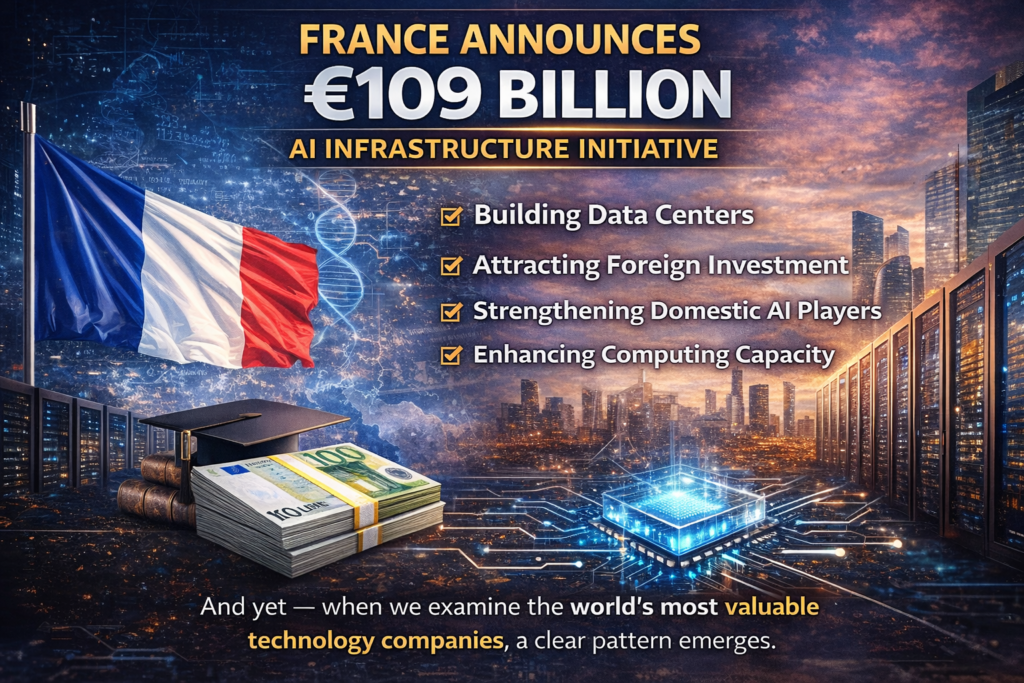
France announced a €109 billion AI infrastructure initiative aimed at:
-
Building data centers
-
Attracting foreign investment
-
Strengthening domestic AI players
-
Enhancing computing capacity
The goal is technological sovereignty.
However, Europe still depends on:
-
American hyperscalers
-
US semiconductor supply chains
-
Global capital flows
The challenge is not starting — it is accelerating fast enough.
The Bigger Structural Reality
Europe excels in:
-
Industrial machinery
-
Semiconductor equipment
-
Enterprise software
-
Green technology
But consumer-facing global digital monopolies require:
-
Hyper-scale markets
-
Aggressive capital
-
Cultural normalization of failure
-
Regulatory agility
Europe’s ecosystem historically prioritized sustainability over speed.
Now the global AI race demands both.
What Founders and Policymakers Can Learn
Macron’s admission is important because it shifts the narrative from blame to structure.
The lesson is universal:
Innovation dominance is not just about intelligence.
It requires alignment between:
-
Market size
-
Capital availability
-
Cultural mindset
-
Policy design
-
Speed of execution
The United States mastered this alignment.
China engineered it centrally.
Europe is trying to redesign it.
India is experimenting with leapfrog models.
The Ecosystem Determines the Outcome
In his conversation with Raj Shamani, Emmanuel Macron did something rare for a head of state — he acknowledged systemic weakness without defensiveness.
He reduced Europe’s tech gap to three structural realities:
-
Insufficient scale integration
-
Misaligned capital flows
-
Limited risk appetite
The coming decade will determine whether Europe reforms these pillars quickly enough to compete in AI, quantum computing, and advanced technologies.
Because in the 21st century, innovation is no longer just about invention.
It is about ecosystem engineering.
And ecosystems either compound — or they stall.
Also Read- Mukesh Ambani’s ₹10 Lakh Crore AI Plan: How Reliance Wants to Make India the Global AI Superpower
Watch Here Podcast
1 thought on “Emmanuel Macron Reveals Why Europe Lost the Big Tech Race to USA & China”