
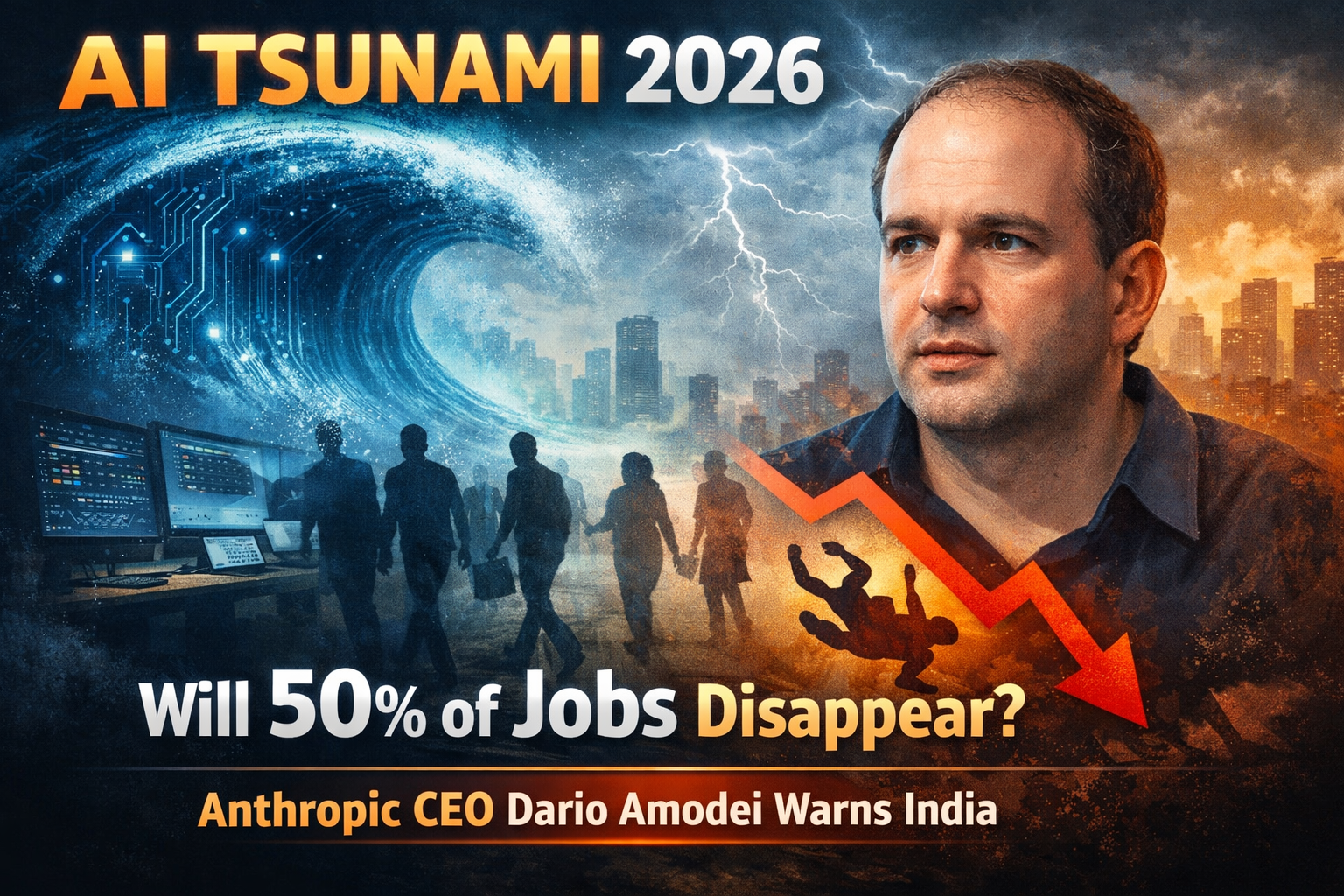
Artificial Intelligence is no longer a distant concept. It is here, it is scaling fast, and according to Dario Amodei, the world may not be fully prepared for what is coming next.
During conversations with Indian entrepreneur Nikhil Kamath, co-founder of Zerodha, and during his recent visit to India for the AI Impact Summit, Amodei compared AI’s rapid rise to a “tsunami.” His warning was direct and unsettling: up to 50% of entry-level jobs could face disruption within the next three years.
That statement alone is enough to trigger concern. But to understand whether this is fear, reality, or somewhere in between, we need to go deeper.
Who Is Dario Amodei and What Is Anthropic?
Dario Amodei is not just another tech CEO making bold claims. He previously worked as a senior research leader at OpenAI, one of the most influential AI labs in the world. In 2021, he co-founded Anthropic, a company focused on building advanced AI systems with a strong emphasis on safety and responsible development.
Anthropic is best known for its AI model “Claude,” which competes with other large language models in coding, reasoning, writing, and enterprise automation. Unlike consumer-focused AI platforms, Anthropic positions itself as an enterprise AI company — meaning it works closely with businesses to integrate AI into real-world operations.
The company has attracted massive funding commitments reportedly in the tens of billions of dollars. Yet, according to Amodei, even that may not be enough in an industry where computing costs, data centers, and scaling demands grow exponentially.
Why Call It an “AI Tsunami”?
When Amodei uses the word “tsunami,” he is not talking about a single dramatic event. He is talking about speed and scale.
Technology has always disrupted industries. But previous revolutions — electricity, the internet, smartphones — unfolded over decades. AI is improving in cycles measured in months. Models are getting better at reasoning, coding, financial analysis, and even complex decision-making.
What makes AI different is that it is a general-purpose technology. It does not impact just one industry. It touches finance, healthcare, software engineering, marketing, research, cybersecurity, and more — all at once.
That breadth creates powerful opportunity. But it also creates widespread vulnerability.
The 50% Job Disruption Warning
Amodei’s most discussed statement is that up to 50% of entry-level jobs may face disruption within three years.
This does not automatically mean 50% unemployment. Disruption can take different forms:
-
Roles being automated
-
Tasks being reduced
-
Hiring slowing down
-
Jobs being restructured
-
Skills becoming obsolete
Entry-level roles are particularly vulnerable because many of them involve structured, repetitive, or rule-based tasks. Today’s AI systems can already:
-
Write and debug code
-
Generate reports
-
Analyze spreadsheets
-
Summarize documents
-
Handle customer queries
-
Draft legal and financial documents
In many companies, junior employees perform exactly these kinds of tasks. If AI can perform them faster and cheaper, the demand for large entry-level hiring could decline.
What This Means for India’s IT Sector
India’s IT services industry has long operated on a pyramid structure. A wide base of junior engineers supports mid-level managers and senior architects. Revenue models often depend on deploying large teams to handle coding, testing, maintenance, and support.
If AI reduces the need for large junior teams, the impact could include:
-
Slower campus recruitment
-
Reduced training batches
-
Shift in billing models
-
Increased demand for highly skilled AI-integrated roles
However, Amodei has clearly stated that companies like Anthropic are not trying to replace IT firms. Instead, he describes AI as “Lego blocks.” Anthropic builds foundational AI models. IT companies can build customized solutions on top of those foundations.
In theory, this creates partnership. In practice, it still changes workforce requirements.
The Business Model Behind the Hype
Interestingly, Amodei has explained that each AI model Anthropic builds is individually profitable when comparing training and serving costs against revenue. The real financial challenge lies in constantly building the next, more powerful model.
AI companies must invest heavily in:
-
High-performance chips
-
Massive data centers
-
Energy infrastructure
-
Advanced research teams
Profitability becomes clear only when scaling stabilizes. Until then, companies reinvest aggressively to stay competitive.
For India, this signals two things: enormous economic opportunity and massive capital intensity.
The Human Side of the Disruption
Beyond economics and corporate strategy lies a deeper issue — people.
When entry-level jobs shrink or change too quickly, it creates:
-
Skill gaps
-
Anxiety among young professionals
-
Wage pressure
-
Increased competition for fewer roles
Unlike past industrial shifts, where new jobs gradually replaced old ones, AI’s speed compresses this transition. The challenge is not just whether new jobs will be created. It is whether they will be created fast enough.
There is also the psychological dimension. A generation that studied engineering, finance, or coding with certain expectations may suddenly face a new reality where AI performs large parts of their job description.
Education, Skills and the Urgency to Upskill
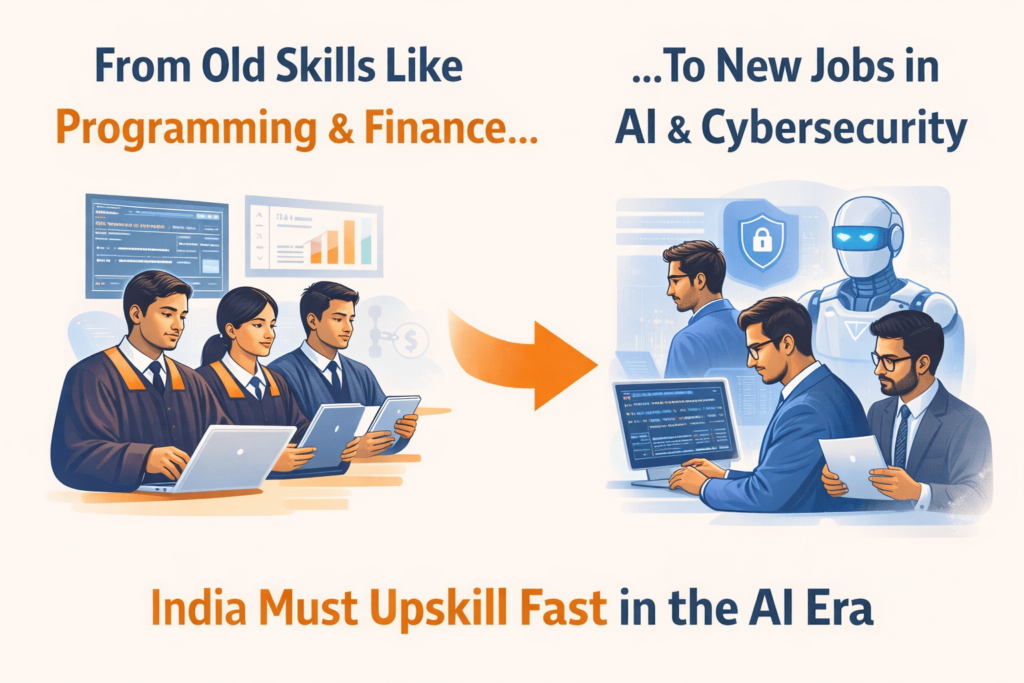
One of the biggest concerns in the AI era is not just job loss — it is skill irrelevance. Many university programs still focus on traditional coding, theoretical finance, and manual workflows. However, AI systems are increasingly capable of performing those same tasks with higher efficiency.
This creates a dangerous gap between what students are learning and what companies may actually need in 2026 and beyond.
India may need to rapidly rethink:
-
Engineering curriculum
-
Corporate training programs
-
AI literacy at school level
-
Government-backed reskilling initiatives
If education does not evolve as quickly as AI, the disruption could feel harsher than necessary.
Potential New Opportunities
While the risks are real, so are the possibilities.
As automation increases, new roles may grow in importance:
-
AI integration specialists
-
AI safety researchers
-
Prompt engineers
-
Cybersecurity experts
-
Data governance professionals
India, with its large technical workforce and startup ecosystem, could benefit significantly if it adapts quickly.
The key variable is adaptation speed.
 Risks vs Opportunities –
Opportunities |
Risks |
|---|---|
Higher productivity |
Entry-level job reduction |
Faster innovation |
Wage pressure |
Global AI partnerships |
Skill mismatch |
New AI-focused careers |
Economic inequality |
Lower operational costs |
Cybersecurity threats |
Are We Prepared?
Amodei has openly admitted that AI progress may be moving faster than regulatory and societal preparedness. Anthropic conducts extensive safety testing on its models to evaluate extreme scenarios such as manipulation or misuse. The company has drawn clear lines against fully autonomous weapons and domestic mass surveillance.
Still, even with safety focus, the broader societal adaptation remains uncertain.
India’s strengths — young population, digital infrastructure, entrepreneurial energy — give it an advantage. But education reform, upskilling programs, and policy clarity will determine whether AI becomes a growth engine or a stress test.
Anthropic Ai Official Website
A Possible 2026 Scenario
Imagine a software graduate in 2026 applying for a job. Instead of asking about coding languages, the interviewer asks:
“How well can you work alongside AI systems?”
The role is no longer about writing basic code. It is about supervising AI-generated code, identifying errors, improving prompts, and ensuring compliance.
The job still exists — but it looks very different.
That is the transformation Amodei is pointing toward.
Dario Amodei’s warning should not be read as panic messaging. It is a call for realism.
AI is powerful. It is scaling rapidly. It will disrupt jobs — especially at the entry level. But it will also create new forms of value and opportunity.
The real question is not whether AI will change the job market. It already is.
The question is whether businesses, governments, and individuals can adapt quickly enough to ride the wave instead of being overwhelmed by it.
If this truly is an AI tsunami, preparation — not denial — will determine who stays afloat.
Also Read – Carlsberg IPO India: ₹5,800 Crore Brewing Opportunity Set to Reshape India’s Beer Market
Also Read – Gold and Stocks Surge in 2026 — Kiyosaki Says It’s a Warning for Global Markets
1 thought on “Anthropic CEO Dario Amodei Warns India -AI Tsunami 2026: Will 50% of Jobs Disappear?”