
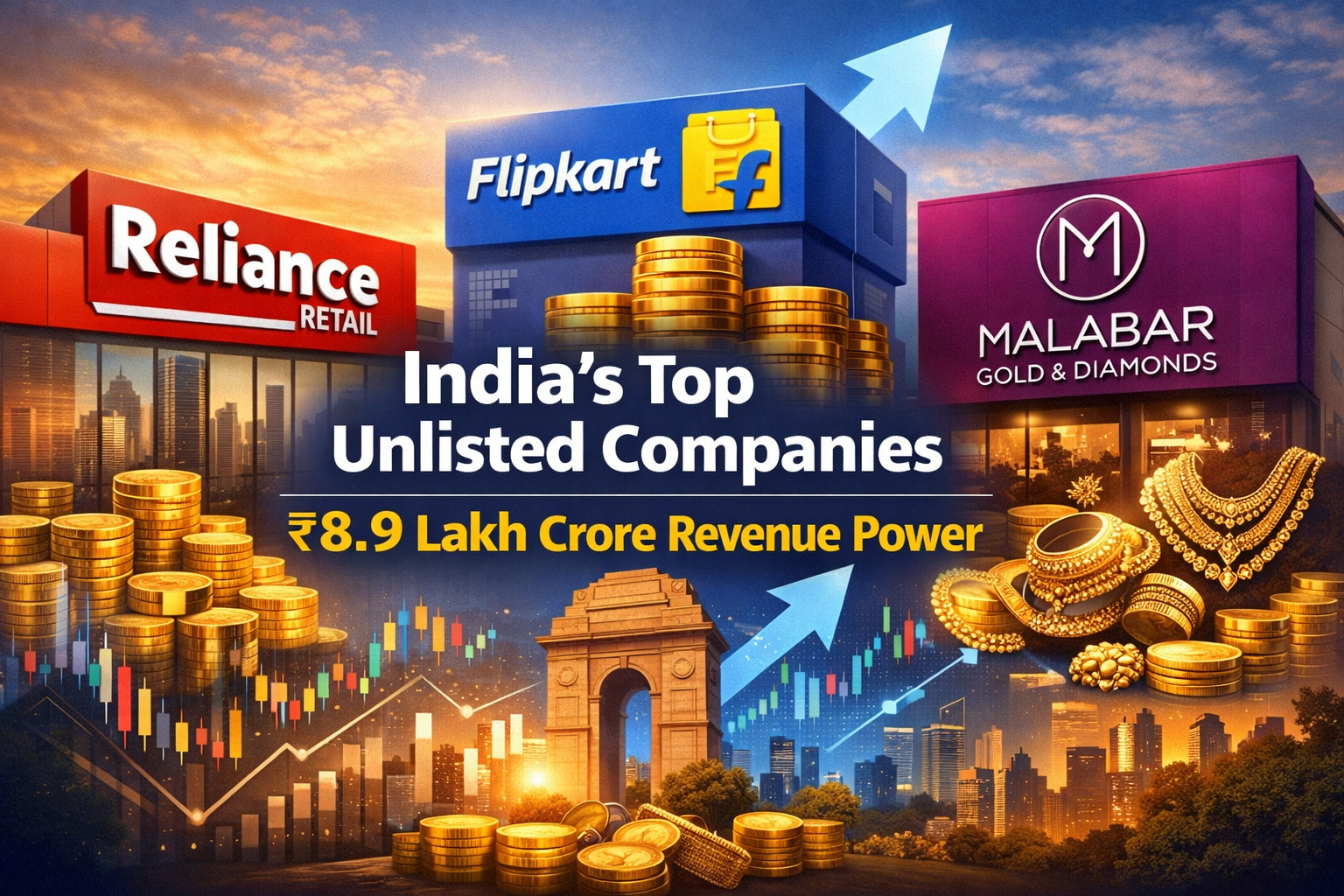
India’s unlisted corporate space is quietly becoming one of the strongest pillars of the country’s economic growth. A recent industry study has highlighted 100 high-potential private companies that have achieved significant scale, consistent revenue growth, and strong profitability — even without being listed on stock exchanges.
At the top of this prestigious list stands Reliance Retail, followed by Flipkart and Malabar Gold & Diamonds. These companies are not yet publicly traded, but their financial performance rivals many established listed giants.
Over the last decade, India’s private corporate ecosystem has expanded significantly, driven by rising domestic consumption, rapid digital adoption, manufacturing incentives, and sectoral reforms. Many of these firms have scaled quietly without accessing public capital markets, building strong operational foundations before considering a stock market listing. The latest rankings underline just how large and mature this unlisted universe has become.
Revenue Leaders Among Unlisted Giants
Reliance Retail emerged as the largest unlisted company in India by revenue, reporting approximately ₹2.7 lakh crore in FY2025. Its dominant position in organized retail, grocery, fashion, and digital commerce continues to strengthen its leadership.
Flipkart secured the second position with revenues of nearly ₹83,000 crore, maintaining its stronghold in India’s e-commerce ecosystem. Malabar Gold & Diamonds ranked third, generating around ₹66,000 crore, reflecting the continued strength of India’s jewellery and retail consumption market.
Collectively, the 100 companies featured in the ranking generated an impressive ₹8.9 lakh crore in revenue in 2025, up from ₹6.7 lakh crore in 2023. This represents a strong 15.2% compound annual growth rate (CAGR) in just two years — a clear signal of the rapid expansion happening in India’s private business space.
Fastest Growing Companies
Several companies have shown extraordinary growth momentum over the last few years:
-
Tata Electronics reported a staggering 3,173% CAGR.
-
Tata Passenger Electric Mobility recorded 904% CAGR growth.
-
JSW One Platforms achieved 522% CAGR.
This surge highlights strong expansion in electronics manufacturing, electric vehicles (EVs), and digital B2B commerce — sectors that are becoming central to India’s industrial transformation.
Valuation and Profitability Snapshot
The combined valuation of these 100 unlisted companies stands at approximately ₹28.5 lakh crore (around $328 billion). To put this into perspective, this valuation exceeds the GDP of several mid-sized global economies.
In terms of profitability, Reliance Retail also led with the highest EBITDA of ₹22,573 crore. It was followed by:
-
Adani Properties – ₹11,332 crore EBITDA
-
Zerodha Broking – ₹5,664 crore EBITDA
Together, all 100 companies delivered a combined EBITDA of ₹1.03 lakh crore, underlining strong operational efficiency.
Structure of India’s Unlisted Ecosystem
The list reflects a balanced mix of traditional and new-age enterprises:
-
Around 50% are family-run businesses.
-
The remaining 50% include professionally managed and new-age ventures.
-
Nearly two-thirds belong to traditional sectors.
-
One-third represent digital-first and innovation-led companies.
This blend demonstrates how India’s legacy industries and modern technology-driven ventures are growing side by side.
Key Financial Overview
| Particulars | Figures (FY2025) |
|---|---|
| Total Revenue (100 companies) | ₹8.9 lakh crore |
| Revenue (FY2023) | ₹6.7 lakh crore |
| 2-Year CAGR | 15.2% |
| Combined Valuation | ₹28.5 lakh crore |
| Combined EBITDA | ₹1.03 lakh crore |
| Highest Revenue | Reliance Retail – ₹2.7 lakh crore |
Reliance Retail Official Website
Flipkart Official Website
Malabar Gold & Diamonds Official Website
 What This Means for Investors
Although these companies have not publicly announced IPO plans, their scale, profitability, and consistent growth suggest strong potential for future public market entry. For investors tracking upcoming IPO opportunities, this segment of India’s corporate landscape could become highly relevant in the coming years.
India’s unlisted space is no longer small or informal — it represents a powerful and structured economic engine that is expanding in size, profitability, and strategic importance.
While none of these companies have formally announced listing plans, market observers believe that a few of them could explore IPO routes in the coming years. If that happens, it could significantly reshape India’s primary market landscape. Investors and market participants will be closely watching this segment as the next potential wave of large public offerings builds momentum.
Also Read- Anthropic CEO Dario Amodei Warns India -AI Tsunami 2026: Will 50% of Jobs Disappear?
Also Read – SEBI Approves 4 IPOs – Alpine Texworld, Anjali Labtech & More Ready to Launch