
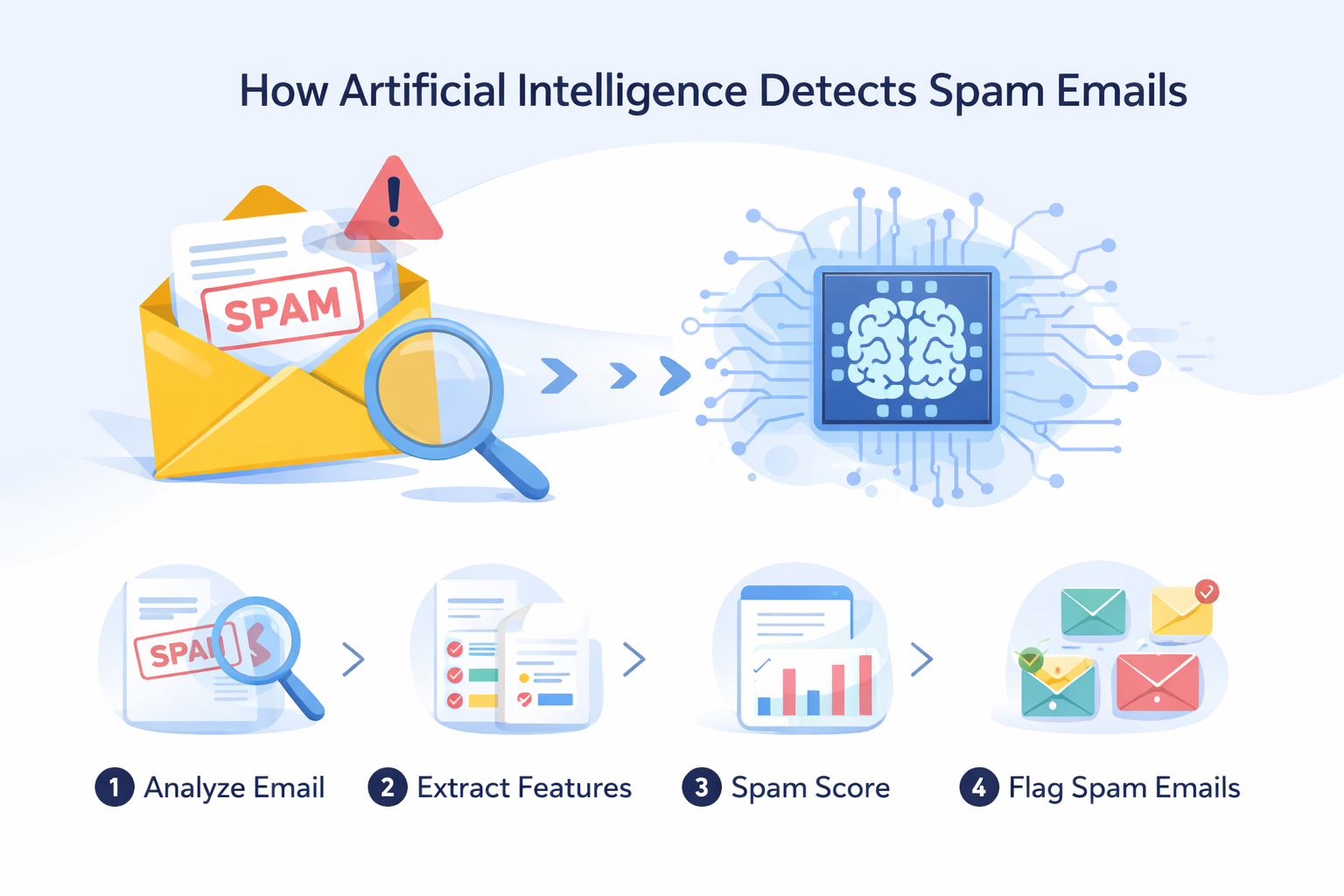
Every day, our inbox fills up with a mix of important emails and irrelevant messages. These rang from work alerts to bills, promotions, newsletters, and sometimes dangerous phishing links aimed at stealing personal information. Sorting through all of this manually is nearly impossible — especially when spam cleverly disguises itself as legit content. That’s where AI Spam Email Detection comes in — a powerful system that uses artificial intelligence to identify unwanted or harmful messages and move them to the spam folder before you even see them.
In this article, we’ll explain AI Spam Email Detection step by step — how it works, why it’s important, what technologies power it, and how it keeps your digital life safer. By the end, you’ll have a complete understanding of this invisible guard protecting your inbox.
1. What Is a Spam Email?
Spam emails are essentially unsolicited messages — the digital form of junk mail. They are usually:
-
Bulk sent to large lists without permission
-
Trying to sell something or trick you
-
Designed to steal data or install malware
In the early days, spam filters used simple rules like blocking messages with certain keywords (“win money”, “free gift”) or suspicious senders. But spammers quickly learned how to evade these rules. They started mixing text inside images, using misspellings, and mimicking real companies to bypass basic filters. This is where AI Spam Email Detection became necessary.
Spam emails are essentially unsolicited messages — the digital form of junk mail. They are usually sent in bulk to promote, deceive, or spread malware.
learn more about how spam filters work on wikipedia – Email Filtering
2. Why AI Spam Email Detection Is a Game-Changer
Spam today isn’t just annoying — it’s dangerous. Many spam emails are used for:
-
Phishing: Pretending to be from trusted services to steal passwords or bank details
-
Malware: Installing harmful software via attachments
-
Fraudulent offers: Tricks designed to make you click or share information
Traditional filters break when confronted with clever tricks. They can’t adapt quickly because they follow fixed rules. AI Spam Email Detection solves this by learning from data and spotting patterns humans might miss.
Here’s why it matters:
-
Learns from millions of real email examples
-
Understands language, behavior, and intent
-
Automatically adapts as spam tactics evolve
Today, major email services like Gmail, Outlook, and Yahoo rely on AI Spam Email Detection combined with machine learning, Natural Language Processing (NLP), and neural networks.

3. Step-by-Step: How AI Spam Email Detection Works
Let’s walk through the actual process — what happens to your email after it arrives.
Step 1: Email Arrival and Data Collection
The moment an email reaches the server, the system captures key details:
-
Sender’s email address and IP
-
Subject line
-
Body text
-
Embedded links and attachments
This raw data becomes the basis for deeper analysis.
Step 2: Feature Extraction — Breaking Down the Content
At this stage, the AI system identifies important indicators — known as features — from the email. These act like clues to judge whether the message is suspicious.
Common features include:
-
Number of links or attachments
-
Unusual language patterns
-
Misspellings or random capital letters
-
Sender history and reputation
These features help the AI model form a numerical representation of the email, which is then passed on to machine learning models for classification.
Step 3: Machine Learning Classification
Here’s where intelligence kicks in.
Instead of applying fixed rules, the system uses Machine Learning (ML) models trained on thousands of labeled emails — both legitimate and spam. Over time, these models learn to spot subtle patterns that humans might miss.
Some common ML techniques used:
-
Naive Bayes Classifier: Calculates likelihood of spam based on word frequency.
-
Decision Trees: Breaks down decisions step by step using branching logic.
-
Neural Networks: Mimic human brain connections to detect complex and hidden patterns.
Because of this training, the system can correctly identify new types of spam — even ones it has never seen before.
Step 4: Scoring and Sorting
Once the email is analyzed, the AI assigns it a score indicating how likely it is to be spam.
-
High score → goes into the Spam folder
-
Low score → stays in Inbox
These scores are dynamic and adjust based on feedback. For example, if you mark something as “Not Spam,” the model learns from that feedback and fine-tunes future predictions.
This continuous learning loop makes AI Spam Email Detection more accurate over time.
4. The Role of NLP (Natural Language Processing)
One of the biggest challenges in spam detection is understanding language — context, tone, and intent.
For example:
-
The word “free” in “Free holiday trip!” is spammy
-
But it’s normal in “Students get free access to study tools”
This difference can only be understood if the system actually interprets meaning — not just matches keywords.
That’s where Natural Language Processing (NLP) steps in. NLP allows the system to understand:
-
Tone of the message (urgent, threatening, promotional)
-
Sentiment and emotional context
-
Intent behind phrases
With NLP, the AI understands why the email was written, not just what words it contains — making detection much more accurate.
5. Core Technologies Powering AI Spam Email Detection
Now let’s take a quick look at the major technologies behind this system:
Machine Learning (ML)
Teaches models to learn from past data and classify emails automatically.
Natural Language Processing (NLP)
Helps the AI understand the meaning, tone, and intent of written language.
Neural Networks and Deep Learning
Handle more complex cases like mixed-content emails, image spams, and disguised phishing attempts.
Together, these technologies make AI Spam Email Detection powerful, adaptive, and reliable.
6. Latest Developments in Spam Filtering
Spam detection has continued to evolve rapidly. Here are some recent upgrades:
-
Image Spam Detection
Spammers often embed text within images to hide spam indicators. AI now uses Optical Character Recognition (OCR) to extract text from images before analysis.
-
Real-Time Link Safety Scanning
Emails containing links are automatically checked against databases of known malicious URLs in real time.
-
Behavioral Pattern Analysis
AI tracks sender behavior — if a known contact suddenly starts sending unusual messages, it gets flagged.
-
Deep Learning and Feedback Loops
Modern systems use advanced deep neural networks that retrain themselves based on user feedback and new data patterns.
For example, Google reported that Gmail’s AI filters block more than 99.9% of phishing and malware emails — a figure achieved through adaptive models and next-generation NLP introduced in late 2025.
7. Why AI Spam Email Detection Works So Well
Here’s why this system has become so effective:
-
High Accuracy: Understands language and intent, not just keywords
-
Self-Improving: Learns continuously from new emails
-
Better Security: Blocks phishing, scams, and malware before user sees them
-
Fewer False Positives: Important emails rarely end up in spam mistakenly
-
Smarter Filtering: Catches hidden and clever spam tricks
Today, major email services like Gmail, Outlook, and Yahoo rely heavily on AI-driven spam filters to protect users from phishing and malware.
(You can check more about Yahoo’s spam filtering and safety policies on the Yahoo Mail Security Center.)
8. Best Practices to Stay Safe Online
AI handles most spam filtering, but you can still stay safer with good habits:
-
Avoid opening emails from unknown senders
-
Don’t click suspicious links or attachments
-
Double-check the sender’s email domain
-
Enable two-factor authentication (2FA)
-
Mark spam and non-spam to train the AI faster
Your inbox becomes smarter when you interact with the filtering system.
AI Spam Email Detection is not just a simple filter — it’s an evolving security shield for your inbox. By combining Machine Learning, NLP, and deep neural networks, it doesn’t just read text — it understands it.
This technology learns from you and millions of others, adapts to new threats, and stays one step ahead of spammers. Today, your email experience is safer, cleaner, and smarter because of it — and this field will only improve with time.
For anyone writing about tech or digital safety, this topic will remain relevant because email is one of the most widely used communication tools in the world.
Also Read – Why Are Laptop Prices Increasing in India? How the AI Boom Is Making Computers More Expensive
Also Read – India’s Biggest Data Centre IPO? Sify Infinity IPO ₹3,700 Crore Issue Could Launch Next Month
Also Read – Anthropic CEO Dario Amodei Warns India -AI Tsunami 2026: Will 50% of Jobs Disappear?
1 thought on “AI Spam Email Detection Explained: How Artificial Intelligence Filters Spam Step-by-Step”