
India and the United States have announced an Interim Trade Framework as a step toward a larger Bilateral Trade Agreement (BTA). This development is important because it comes after rising tariff tensions and concerns over penalties linked to India’s Russian oil purchases. The interim framework is not a final Free Trade Agreement, but it sets the direction for future trade cooperation and tariff restructuring between both countries.
India–US Interim Trade Deal:-
1. US Cuts Tariffs on Indian Goods to Around 18%
The biggest headline is that the United States has reduced reciprocal tariffs on several Indian exports to around 18%. This is being seen as a major relief for Indian exporters because earlier tariffs on multiple Indian goods were much higher due to reciprocal measures and penalties.
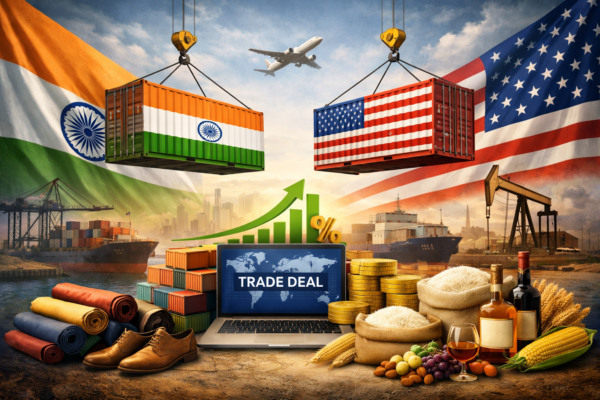
This 18% tariff level is expected to benefit Indian export-heavy sectors like:
-
Textiles and garments
-
Leather products and footwear
-
Plastics and rubber products
-
Chemicals and industrial goods
This tariff cut can directly improve India’s export competitiveness in the US market, especially for manufacturing-driven industries.
2. US Removes Penalty Tariff Linked to Russian Oil Purchases
According to Reuters, the United States has removed the punitive tariff imposed on India that was linked to India’s purchase of Russian oil. This is a major development because such penalty tariffs were increasing uncertainty for Indian exporters.
This step reduces trade pressure on India and lowers the risk of sudden export disruption.
3. India Agrees to Lower Tariffs on Selected US Goods
India has also committed to reduce or eliminate import duties on several US products. Reports indicate that tariff easing is expected for products like:
-
Tree nuts
-
Fruits and processed foods
-
Soybean oil
-
Animal feed-related goods
-
Wine and spirits
This indicates India is offering selective market access to the US in return for tariff relief on Indian exports.
4. Target of $500 Billion Trade Expansion
One of the most important points mentioned in multiple reports is the trade expansion goal of around $500 billion over the next 5 years. This signals the ambition of both countries to sharply increase bilateral trade flows.
To understand the scale:
-
$500 billion ≈ ₹41,500 lakh crore (approx.)
If achieved, this would make India–US trade one of the biggest bilateral trade relationships in the world.
What Is Not Included in the Deal?
1. India Keeps Major Agriculture and Dairy Products Protected
India has reportedly kept sensitive food categories outside tariff cuts. This includes products such as:
-
Wheat
-
Rice
-
Milk and dairy products
-
Poultry
This is crucial because these sectors directly impact farmers and domestic price stability.
India has protected its core farm economy while still offering limited agricultural access in less sensitive categories.
2. No Final Bilateral Trade Agreement Yet
This is only a framework, meaning:
-
The deal is not yet a fully legally binding Free Trade Agreement
-
Many sectors will be negotiated further before the final treaty is signed
3. Services and Digital Trade Rules Still Not Fully Clear
Important issues like:
-
IT services
-
digital trade rules
-
cross-border data regulations
-
immigration and work visa movement
are not fully finalized under this interim framework and will likely be part of the next negotiation phase.
What Does This Deal Mean for India?
This deal is being seen as strategically important because the United States is among India’s most valuable export markets. A tariff reduction to around 18% can support India’s manufacturing exports at a time when global companies are diversifying supply chains away from China.
The agreement can also help India in sectors like textiles, footwear, chemicals, and industrial exports, which are among the biggest employment generators.
This deal supports India’s long-term objective of becoming a global manufacturing and export hub.
Expected Impact on Indian Economy and Industries
Positive Impact Areas
-
Indian exporters get better pricing advantage in the US market due to lower tariff burden.
-
Manufacturing industries such as textiles and leather may see higher export demand.
-
Trade stability improves long-term business confidence.
-
Removal of penalty tariffs reduces uncertainty for Indian companies exporting to the US.
Possible Challenges for India
-
Lower tariffs on US agricultural and food products could increase competition for Indian import substitutes.
-
Future negotiations may again raise pressure on India to open dairy and major agriculture sectors.
-
India may need to balance domestic farmers’ interests with trade expansion commitments.
The India–US Interim Trade Framework is a major development because it brings tariff relief for Indian exporters, including a key reduction of US reciprocal tariffs to around 18%, and also removes penalty-related trade pressure linked to Russian oil purchases. It also sets a high ambition of achieving $500 billion trade expansion in 5 years, while India has still managed to protect its most sensitive farm and dairy sectors.
This interim deal is a strong short-term win for Indian exports, and it could become a long-term economic boost if a full bilateral trade agreement is finalized successfully.
Read More – RBI Keeps Repo Rate Unchanged at 5.25% in February 2026 Policy Meet