

Artificial Intelligence (AI) is no longer a “future technology” — it is already shaping how businesses run, how people learn, how doctors diagnose diseases, and even how governments plan development. But the biggest question is not whether AI will grow, but who will control it and who will benefit from it.
At the India AI Impact Summit 2026, held in New Delhi, the world heard some of the strongest statements on AI’s future from global leaders like Sam Altman (OpenAI CEO), Sundar Pichai (Google CEO), and the UN Secretary-General. However, the speech that created the biggest buzz in India came from Mukesh Ambani, Chairman of Reliance Industries.
Ambani’s announcement wasn’t just another corporate plan — it felt like a national mission. With a massive investment plan and a clear message, he signaled that India is preparing to become a global AI powerhouse.
The Big Announcement: ₹10 Lakh Crore Investment in AI
Mukesh Ambani announced that Reliance and Jio are planning to invest around ₹10 trillion (₹10 lakh crore) in AI infrastructure, computing capacity, and AI-driven services over the next seven years.
This is one of the largest AI-related investment visions ever announced by an Indian corporate group.
But what made the statement even more impactful was Ambani’s powerful line:
“India cannot afford to rent intelligence.”
This statement is significant because it addresses a key risk: India becoming dependent on foreign AI infrastructure. Today, most of the world’s AI computing is controlled by a handful of global cloud giants. If India only depends on them, then AI access becomes expensive, limited, and controlled externally.
Ambani’s message was clear: India must build its own ecosystem.
Why Reliance’s AI Plan Could Be a “Jio Moment” for AI
If you remember the telecom revolution, Jio didn’t just launch a network — it changed the entire pricing structure of mobile internet in India. Data became cheaper, and suddenly millions of people could access the digital world.
Ambani is now making a similar promise with AI:
Jio will reduce the cost of AI, the way it reduced the cost of data.
If this becomes reality, AI tools that currently feel “elite” could become accessible to students, small business owners, doctors, farmers, and even local government offices.
That’s why many experts are calling this the possible “Jio moment for AI.”
AI is Not Just a Tech Story — It’s a Human Story
Most people hear “AI” and immediately think about robots replacing jobs. That fear is real. Across the world, employees worry that AI will automate tasks and reduce hiring.
Ambani directly addressed this concern.
He claimed that AI will not destroy jobs — instead it will create new opportunities, especially high-skill jobs.
“AI will create high-skill opportunities.”
This is a comforting statement, but it also comes with responsibility. AI can create jobs only if people are trained properly. Otherwise, it may widen inequality between skilled and unskilled workers.
So, Ambani’s statement is not just optimism — it is a challenge for India’s education and skill development system.
Global Voices at the Summit: What Others Said
Mukesh Ambani wasn’t alone in pushing the “inclusive AI” narrative. Other global leaders made similar points, strengthening the summit’s theme.
Sam Altman (OpenAI CEO)
Sam Altman highlighted that democratization of AI is the safest path forward. That means AI must be accessible and not limited to a few rich players.
UN Secretary-General’s Warning
The UN chief warned that AI should not be left to the “whims of a few billionaires.” This was a direct signal that AI needs governance and fairness.
Sundar Pichai (Google CEO)
Pichai said AI will reshape the workforce, but it can also help emerging economies if deployed correctly.
Together, these statements create a clear narrative:
AI will be powerful, but the world wants it to be responsible and inclusive.
Key Highlights of Mukesh Ambani’s AI Vision (Quick Table)
Here’s a clean table summary you can use in your blog/article:
| Topic | Mukesh Ambani’s Key Message | Why It Matters |
|---|---|---|
| Investment Plan | ₹10 lakh crore in next 7 years | One of India’s biggest AI bets |
| AI Cost | Reduce AI cost like Jio reduced data | Makes AI affordable for masses |
| Independence | “India cannot afford to rent intelligence” | Avoid dependency on foreign cloud AI |
| Jobs Impact | AI will create high-skill jobs | Counters fear of unemployment |
| India’s Role | India can become a global AI leader | Boosts global positioning |
| AI Accessibility | AI should reach every citizen | Inclusive growth & innovation |

What Does “Renting Intelligence” Actually Mean?
Ambani’s phrase “rent intelligence” refers to India paying huge costs to use AI systems owned by foreign companies.
For example:
-
Cloud AI tools
-
AI computing GPUs
-
AI APIs (ChatGPT-like services)
-
Data processing platforms
If India depends heavily on imported AI infrastructure, the cost will always remain high and strategic control will remain outside the country.
This is why countries like the US and China are investing heavily in AI chips, data centers, and computing infrastructure.
Ambani’s plan suggests Reliance wants India to have a domestic AI backbone.
Which Sectors Can Benefit the Most From Affordable AI in India?
If AI becomes cheaper like data, then the impact will not be limited to IT companies. It could reshape India’s core sectors:
1. Healthcare
-
Faster diagnosis using AI tools
-
AI-powered rural healthcare support
-
Affordable medical research and drug discovery
2. Education
-
Personalized learning for students
-
AI tutors in regional languages
-
Better exam preparation tools
3. Agriculture
-
Crop prediction and disease detection
-
AI-based weather analysis
-
Smarter irrigation and fertilizer planning
4. Small Businesses & Startups
-
AI customer support bots
-
Marketing automation
-
AI-based inventory and billing systems
5. Government Services
-
Faster processing of public schemes
-
AI fraud detection
-
Better policy planning using predictive models
This is where AI becomes more than technology — it becomes a tool of social transformation.
The New Delhi Frontier AI Commitments: India’s Push for Ethical AI
At the summit, India also unveiled the “New Delhi Frontier AI Impact Commitments”, a voluntary framework for safe and ethical AI development.
This is important because AI isn’t only about business growth — it also involves:
-
data privacy
-
bias and discrimination
-
misinformation
-
deepfakes
-
national security risks
By pushing an international framework, India is signaling that it wants to play a leadership role in global AI governance.
The Biggest Opportunity
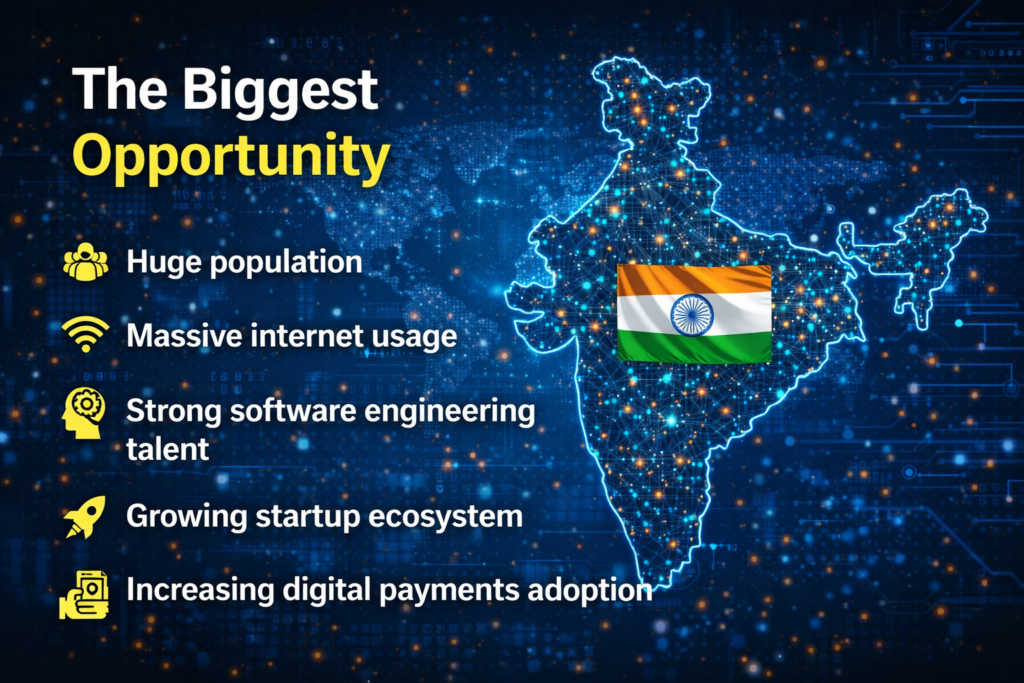
India has one massive advantage that many countries do not: scale.
-
Huge population
-
Massive internet usage
-
Strong software engineering talent
-
Growing startup ecosystem
-
Increasing digital payments adoption
If Reliance builds AI infrastructure at scale, India could become a global hub not just for AI consumption but also AI creation.
Many analysts believe India can replicate what it did with IT services — but this time in AI products and AI platforms.
AI Success Will Need More Than Money
Even ₹10 lakh crore investment won’t guarantee success if India fails in a few key areas:
1. AI Education & Upskilling
If millions of youth are not trained in AI skills, the workforce may struggle.
2. Data Privacy Laws
AI thrives on data. But data misuse can create public distrust. India needs strict safeguards.
3. Energy & Infrastructure
AI data centers require massive electricity and cooling systems. India must expand sustainable energy capacity.
4. Ethical AI Governance
Deepfake scams and misinformation are already rising. AI adoption must be balanced with strong regulation.
So yes, the opportunity is huge — but execution is everything.
What This Means for Investors and the Stock Market
From an investment point of view, Ambani’s AI vision could be a major long-term positive trigger for sectors like:
-
Data centers
-
Semiconductor ecosystem
-
Renewable energy
-
Cloud computing
-
Telecom and digital services
-
AI software startups
If Reliance builds large AI infrastructure, it may also lead to:
-
partnerships with global chipmakers
-
AI platforms built under Jio ecosystem
-
new product launches under Reliance Digital services
This could become the next growth chapter after telecom and retail.
A Defining Moment for India’s AI Journey
Mukesh Ambani’s AI speech at the India AI Impact Summit 2026 was not just a business announcement. It was a statement of ambition.
His message is simple but powerful:
India should not depend on others for AI.
India should build its own intelligence infrastructure.
And AI should be affordable for everyone.
Whether this becomes reality will depend on execution, policy support, and skill development. But one thing is clear: India is now in the AI race — and this time, it wants to lead, not follow.
If Reliance truly succeeds in making AI as affordable as mobile data, then this could be remembered as the beginning of India’s biggest technological revolution.
Also Read – What is Artificial General Intelligence? Meaning, Examples, Timeline & Future Impact Explained (2026)
Also Read –How Agentic AI Is Quietly Revolutionizing Procurement in 2026 | Full Explanation & Insights
2 thoughts on “Mukesh Ambani’s ₹10 Lakh Crore AI Plan: How Reliance Wants to Make India the Global AI Superpower”