
In early 2026, a surprising market pattern is catching the attention of global investors: both gold and stocks are surging to record highs at the same time. According to renowned financial author Robert Kiyosaki, best known for his book Rich Dad Poor Dad, this rare occurrence is not a sign of prosperity but a warning signal that something deeper might be wrong with the global financial system.
Historically, gold and equities have an inverse relationship. When the stock market thrives, investors tend to sell gold and move into riskier assets. When uncertainty rises, gold becomes the preferred safe haven. But now, both are rising simultaneously — and Kiyosaki says that could mean the system is quietly cracking beneath the surface.
The Rare Double Rally: Why It Matters
Gold and stocks don’t usually move in the same direction. Stocks reflect optimism about economic growth, corporate profits, and credit stability. Gold reflects fear — protection from inflation, war, or financial instability.
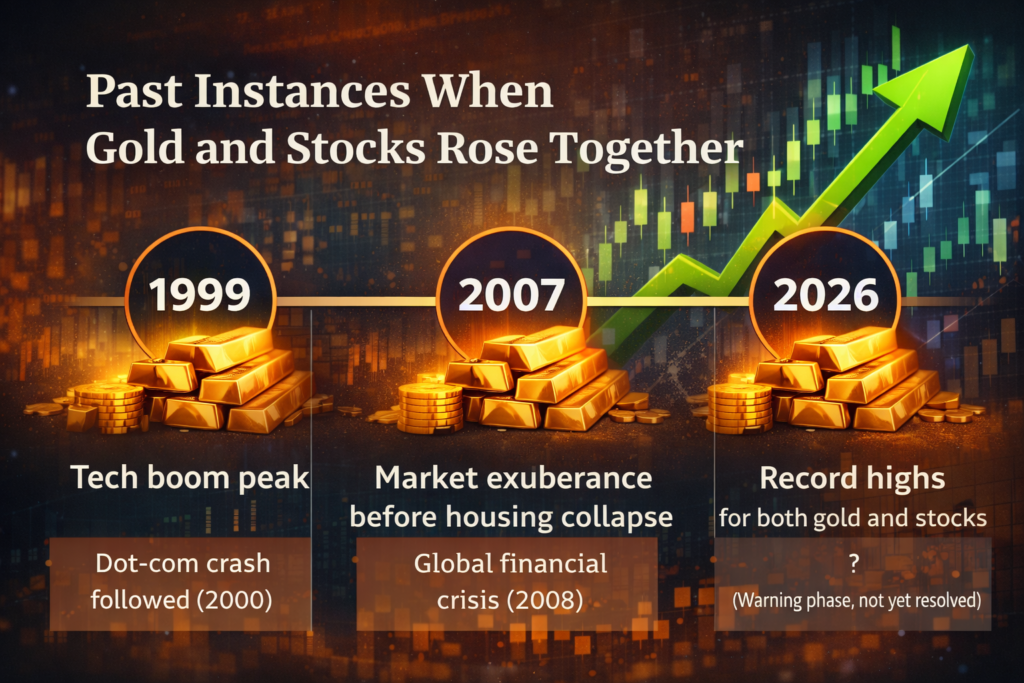
Kiyosaki pointed out that this pattern has happened only twice before in modern history:
Year |
Event |
What Happened Next |
|---|---|---|
1999 |
Tech boom peak |
Dot-com crash followed (2000) |
2007 |
Market exuberance before housing collapse |
Global financial crisis (2008) |
2026 |
Record highs for both gold and stocks |
? (Warning phase, not yet resolved) |
When gold and equities rise together, it often means investors are pricing in risk incorrectly. Either gold is overreacting to fear, or equities are ignoring potential danger. According to Kiyosaki, history shows that it’s usually the stock market that corrects — not gold.
What Robert Kiyosaki Said Recently
In his recent social media post, Kiyosaki wrote:
“When stocks and gold rise together, pay attention. This has only happened twice before: in 1999 and 2007. Both times were followed by crashes. Gold doesn’t go up because it’s popular. It goes up because the smart money sees trouble coming.”
He added that central banks are aggressively buying gold right now, which is a major red flag. These institutions don’t speculate for profit; they hedge against long-term risks such as currency devaluation and financial instability.
“Gold doesn’t go up. Paper money goes down,” Kiyosaki emphasized, reminding investors that gold’s value stays stable while fiat currencies lose purchasing power.
Why Central Banks Are Buying Gold
One of the most striking trends in recent years has been the surge in central bank gold purchases. According to data from the World Gold Council, central banks bought more than 1,000 tonnes of gold in 2023 and continued accumulating in 2024 and 2025.
Their reasons include:
-
Protection from U.S. dollar weakness
-
Geopolitical instability (Russia-Ukraine, Middle East tensions, China-U.S. trade issues)
-
Inflation and debt concerns in major economies
When big financial players move away from paper assets and into hard assets like gold, it often signals they expect long-term instability in currency systems or government debt markets.
The Risk of Mispriced Optimism
Kiyosaki warns that the current market sentiment feels similar to the years leading up to previous crashes. Investors, flush with liquidity and optimism, continue to push equity prices higher despite slowing growth, high global debt, and persistent inflation.
This mispricing of risk is dangerous because it creates a false sense of security. As Kiyosaki puts it, “When protection assets rise alongside risk assets, the system is sending a warning.” In other words, gold rising at the same time as stocks means smart investors are quietly preparing for turbulence while retail investors are still celebrating record highs
Why Gold Is Different from Other Assets.
Gold has a unique position in the global financial system. It doesn’t rely on company earnings, interest rates, or credit markets. It’s a neutral reserve of value that has preserved wealth for thousands of years.
Stocks, on the other hand, depend heavily on three fragile foundations:
-
Earnings growth
-
Low borrowing costs
-
Stable credit conditions
If any of these weaken, stock valuations can drop rapidly. Gold, by contrast, tends to hold its ground or even appreciate when confidence in those systems falls.
Cracks in the Foundation: Early Signs
Analysts observing the global economy have started identifying cracks similar to those seen before earlier crises:
-
Rising corporate debt levels amid higher interest rates
-
Weak productivity growth in developed economies
-
Growing fiscal deficits across the U.S., U.K., Japan, and Europe
-
Geopolitical flashpoints adding uncertainty to trade and investment
Meanwhile, gold has quietly climbed above $2,400 per ounce, while major stock indices like the S&P 500 and FTSE 100 continue setting new records. The combination, while exciting on the surface, may actually reflect hidden fear beneath the optimism.
Lessons from History
The 1999 and 2007 patterns offer valuable lessons. Both times, optimism was overwhelming. Investors ignored warning signs because markets seemed unstoppable. Gold rose quietly as a small group of investors and institutions began to prepare for a downturn.
When the correction came, gold protected value, while equities fell sharply.
In 1999–2000, tech valuations collapsed by over 70%. In 2007–2009, global equities lost more than half their value.
This doesn’t mean 2026 will follow the same path immediately, but it suggests a cautionary phase is underway.
What Investors Should Watch Now
Kiyosaki’s message is not about panic but awareness. Smart investors should monitor these indicators:
Indicator |
What It Means |
Current Trend (2026) |
|---|---|---|
Gold Prices |
Fear or loss of faith in paper assets |
Rising sharply |
Stock Valuations |
Confidence in earnings and growth |
Near record highs |
Interest Rates |
Pressure on debt-heavy firms |
Staying elevated |
Central Bank Gold Buying |
Institutional risk hedging |
At record levels |
Debt-to-GDP Ratios |
Sustainability of growth |
Increasing globally |
A divergence between optimism in stocks and caution in gold buyers is worth paying attention to. As Kiyosaki notes, smart money moves before the headlines.
Expert Opinions Beyond Kiyosaki
Other analysts share a similar tone of caution. Economists at Bloomberg Intelligence and Morgan Stanley have pointed out that liquidity-driven rallies can hide underlying fragility. Even if no immediate crash occurs, volatility tends to rise when both gold and equities move in tandem.
A report from JP Morgan recently noted that “excessive optimism in equity valuations, combined with increased demand for gold as a hedge, indicates a late-cycle environment.” In simpler terms, the financial system might be at a turning point where both fear and greed are driving prices.
Is a Crash Imminent?
Kiyosaki himself clarified that he is not predicting an immediate collapse, but rather pointing to the quiet buildup of systemic stress. Financial markets can stay irrational for long periods before sentiment shifts.
“The cracks show up in gold first,” he said. “Most people wait for headlines, but the rich, they watch signals.”
This statement underlines the mindset of institutional investors who act preemptively rather than reactively.
The Broader Message: Financial Education Matters
Beyond the short-term warning, Kiyosaki’s broader message remains consistent with his financial philosophy: individuals must educate themselves about money, debt, and real assets.
He often contrasts paper assets (stocks, bonds, currencies) with tangible stores of value (gold, silver, real estate). His belief is that while the financial world runs on promises, true wealth lies in assets that don’t depend on trust
What This Means for Everyday Investors.
For retail investors, this doesn’t mean selling all stocks or buying only gold. Instead, it means:
-
Diversify portfolios across asset types.
-
Avoid excessive leverage or speculative bets.
-
Hold some real assets as insurance, not speculation.
-
Watch central bank moves — they often foreshadow policy shifts.
-
Stay informed and understand historical parallels.
Kiyosaki’s warning can be viewed as an invitation to prepare, not panic.
As 2026 unfolds, the simultaneous rise in gold and stocks may prove to be one of the year’s most telling economic signals. Whether it leads to another major correction or simply a phase of adjustment remains to be seen. But as history shows, when protection assets and risk assets rally together, it’s rarely a coincidence.
Robert Kiyosaki’s warning echoes a simple truth: markets may be celebrating, but gold never cheers without a reason. It listens to whispers of fear long before the world hears the crash.
Robert Kiyosaki Statement
Also Read – Why UK Manufacturing Is Under Pressure in 2026: Rising Energy Costs, Falling Investment and Global Impact
Also Read – US Supreme Court Blocks Trump’s Global Tariffs: Big Relief for India, Markets Rally as Trade Tensions Ease