
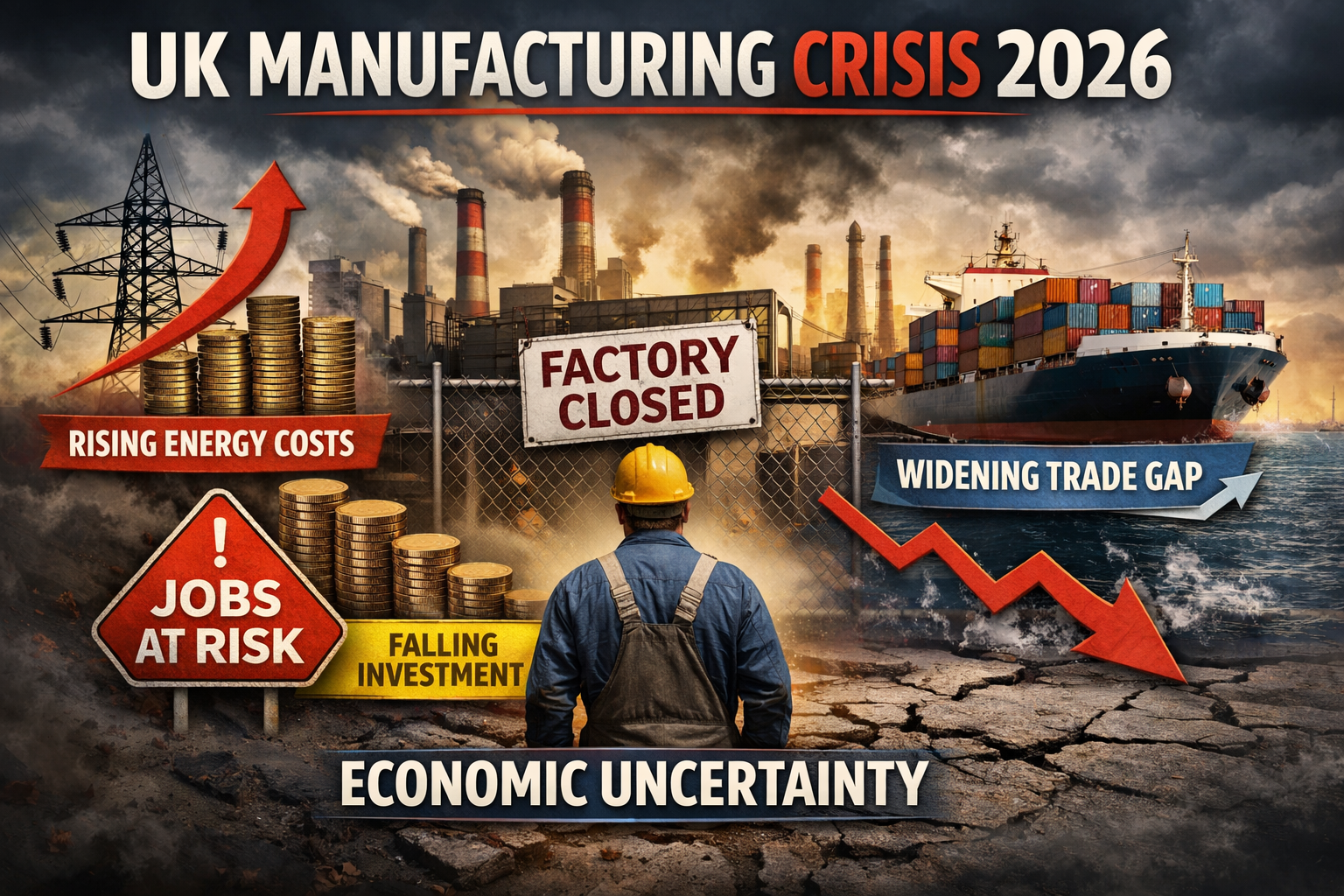
The United Kingdom is entering 2026 with growing concerns about the future of its manufacturing sector. Rising energy prices, reduced industrial investment, and a widening trade gap are creating serious pressure on businesses across the country. Industry leaders are warning that if structural issues are not addressed soon, Britain could risk losing its position as a strong manufacturing economy.
This challenge has been building for several years, but in 2026 the situation appears more critical than ever.
Energy Prices: The Main Pressure Point
For manufacturers, energy is not just another expense — it is a core production input. When electricity and gas prices rise sharply, factories feel the impact immediately.
Over the past few years, UK industrial energy costs have remained significantly elevated compared to pre-Ukraine war levels. Even though global markets have stabilised somewhat, British businesses are still paying much more for power than they did earlier.
This has created multiple problems:
-
Profit margins are shrinking
-
Production costs are increasing
-
Price competitiveness in global markets is weakening
-
Expansion plans are being delayed
Many medium-sized manufacturers are reportedly paying far more for electricity compared to competitors in Europe and North America. When global buyers compare costs, such differences matter.
Investment Is Slowing –
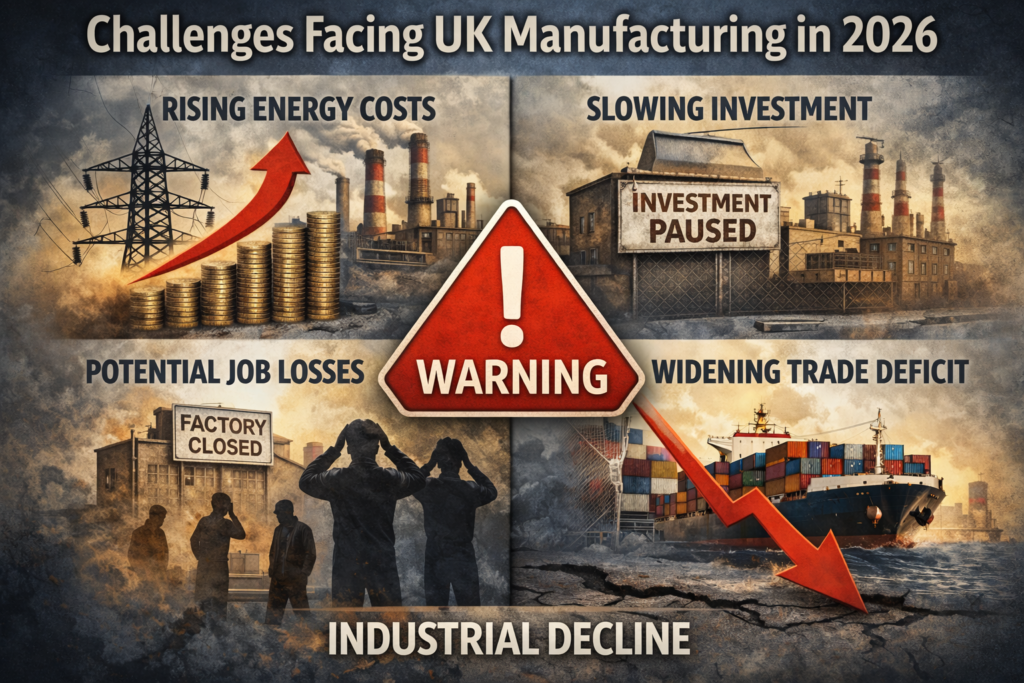
One of the biggest warning signs in 2026 is the decline in industrial investment.
A significant portion of UK businesses have either reduced or postponed investment plans due to rising operating costs. Instead of expanding factories or upgrading machinery, companies are conserving cash.
This creates a dangerous cycle:
Higher costs → Lower investment → Slower productivity growth → Weaker competitiveness.
Without fresh capital investment, industries struggle to modernise, automate, or transition toward cleaner technologies.
Impact on Jobs and Production
When companies face prolonged financial stress, the next step is often cost-cutting.
Possible consequences include:
• Workforce reductions
• Reduced production capacity
• Temporary shutdowns
• Permanent factory closures
• Relocation of operations abroad
Some energy-intensive industries such as chemicals and heavy manufacturing have already shown signs of strain. If conditions do not improve, the risk of broader industrial contraction increases.
Trade Deficit Adds to Concerns
The UK’s trade performance in goods has weakened recently. A widening goods trade deficit indicates that the country is importing more than it exports in manufactured products.
While the services sector continues to perform relatively well, manufacturing remains essential for balanced economic growth.
A weak manufacturing base can lead to:
-
Greater dependency on foreign supply
-
Reduced export earnings
-
Pressure on currency stability
-
Slower regional economic development
Manufacturing plays a major role outside London, particularly in industrial regions. Any sustained slowdown could deepen regional inequality.
Structural Challenges in the Energy System
Beyond global energy shocks, there are domestic challenges as well.
Industry observers point to:
-
Ageing infrastructure
-
Regulatory complexity
-
Grid inefficiencies
-
Limited long-term pricing stability
Businesses argue that energy policy reform must focus not only on short-term price relief but also on improving system efficiency and reliability.
Transitioning toward net zero is another challenge. While green energy investment is necessary, high costs make it harder for firms to invest in cleaner technologies.
Government Support — Is It Enough?
The UK government has introduced targeted support for certain energy-intensive industries. However, many business leaders feel that broader reform is required.
Temporary relief measures may help in the short run, but manufacturers are looking for:
-
Long-term price certainty
-
Competitive industrial energy tariffs
-
Policy clarity
-
Infrastructure upgrades
Without these, investor confidence may remain weak.
Why 2026 Is a Turning Point –
This year is being seen as a critical moment for Britain’s industrial future.
If reforms accelerate and costs stabilise, the UK could rebuild competitiveness. However, if high energy prices persist, companies may increasingly consider moving operations to countries with cheaper production costs.
In a global economy where supply chains are flexible, capital moves quickly toward efficiency.
What Does This Mean for India?
Although this is a UK issue, India may experience indirect effects.
1️⃣ Trade Impact
If UK manufacturing slows:
-
Demand for certain Indian exports may weaken
-
Industrial partnerships could slow down
-
Bilateral trade growth may moderate
2️⃣ Investment Impact
British firms operating in India may delay expansion if parent companies face financial pressure.
3️⃣ Opportunity for Indian Manufacturers
At the same time, India could benefit.
If UK production becomes too expensive:
-
UK importers may shift sourcing to India
-
Indian exporters in textiles, chemicals, auto components, and engineering goods could gain market share
-
India’s cost advantage may strengthen
In this sense, global industrial shifts can create both risks and openings.
The Bigger Economic Picture
Manufacturing is not just about producing goods. It drives:
-
Employment
-
Regional development
-
Innovation
-
Export strength
-
Economic resilience
If the UK’s industrial base shrinks significantly, the long-term economic consequences could extend beyond short-term growth numbers.
Energy policy, investment climate, and industrial strategy must work together to prevent that outcome.
The pressure on UK manufacturing in 2026 reflects a broader global reality: energy costs, geopolitical uncertainty, and competitive positioning are deeply interconnected.
High industrial energy prices are squeezing margins, slowing investment, and raising concerns about long-term competitiveness.
For the UK, the coming months will determine whether structural reforms can restore industrial strength — or whether the country gradually loses ground in global manufacturing.
For India, the situation offers both caution and opportunity. In a shifting global industrial landscape, agility and cost competitiveness will matter more than ever.
Also Read – Truhome Finance IPO Approved by Shareholders – FY25 Profit ₹286 Crore, Listing Soon?
Also Read – AI Impact Summit 2026: India’s Vision for Responsible Artificial Intelligence
1 thought on “Why UK Manufacturing Is Under Pressure in 2026: Rising Energy Costs, Falling Investment and Global Impact”