
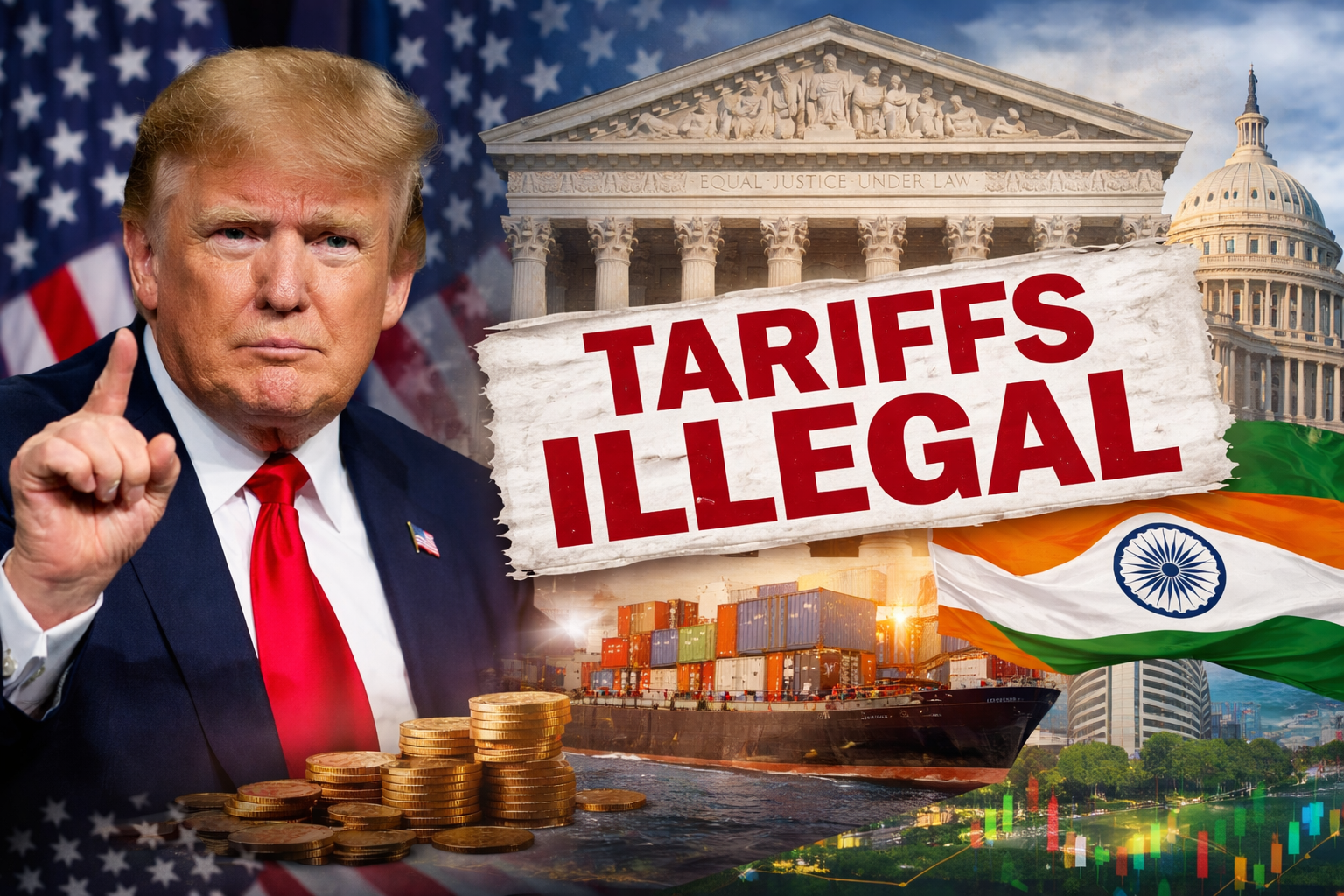
On February 20, 2026, the U.S. Supreme Court delivered a landmark ruling that struck down most of former President Donald Trump’s sweeping global tariffs, holding that Trump exceeded his authority by imposing them under a 1977 emergency powers law. This decision — issued in a 6-3 decision led by Chief Justice John Roberts — not only undercuts one of the central pillars of Trump’s economic agenda but also has broad implications for global trade, U.S. constitutional law, international markets, and countries like India that were directly affected by the tariff regime.
The ruling represents one of the clearest judicial rebukes of executive power in recent U.S. history, setting off a chain of reactions across financial markets and geopolitics worldwide.
What the Supreme Court Actually Ruled
At the centre of the case were “reciprocal tariffs” — broad import taxes that the Trump administration imposed last year on goods from many of America’s trading partners. Trump had justified these tariffs by invoking the International Emergency Economic Powers Act (IEEPA) of 1977, a law originally designed to give presidents limited authority to respond to sudden and specific emergencies.
In its ruling, the Supreme Court held that IEEPA does not — and cannot — authorize a president to impose sweeping import tariffs on dozens of countries. Tariffs, the Court said, are essentially taxes on imports, and only Congress has the constitutional authority to impose taxes, including tariffs. The justices pointed out that IEEPA makes no mention whatsoever of tariff powers, and Congress has repeatedly used other statutes when it intended to delegate tariff authority — making it clear that emergency powers were not meant for this purpose.
The three dissenting justices — Kavanaugh, Thomas, and Alito — argued that the president’s actions were justified under past precedent, but the majority was not persuaded.
Why This Is a Big Deal
There are two major reasons why the ruling matters:
1. A Constitutional Check on Power
For decades, U.S. presidents have used a mix of statutes and tools to manage trade policy. But no administration had ever used a broad emergency law like IEEPA to justify tariffs on virtually every country in the world. The Supreme Court’s decision sends a clear message: executive overreach into essential fiscal policy — like tariffs — must be grounded in clear congressional authority.
This is not just a trade case — it is a constitutional precedent about the limits of presidential power, particularly when it comes to economic policy that has wide-ranging global effects.
2. Practical Impact on Trade and Markets
By ruling most of Trump’s tariffs illegal, the Supreme Court upended global trade expectations built over the last year. Countries that had been slapped with high tariffs — including allies and major trading partners — now have a pathway toward tariff relief or potential refunds.
The ruling, however, did not affect sector-specific tariffs imposed on items like steel, aluminium and certain automotive products under other legal statutes (such as Section 232 of the Trade Expansion Act). These remain in place.
Immediate Market Reaction — Stocks Rally, Uncertainty Eases
The verdict started a strong positive reaction in financial markets:
-
U.S. stock markets jumped as investors welcomed the removal of a major source of trade uncertainty. Major indices such as the Dow Jones Industrial Average, S&P 500 and Nasdaq all climbed on the news.
-
Global markets rallied — including European and Asian equities — as the prospect of broad trade barriers receding eased investor concerns in export-oriented economies.
-
Currencies and bonds responded, with the U.S. dollar weakening modestly and bond yields rising, reflecting improved risk sentiment and higher growth expectations.
In simple terms: investors saw clarity and reduced trade risk, which boosted confidence across asset classes.
What Trump and the Administration Are Saying — Backup Plans
Unsurprisingly, the Trump administration expressed disappointment with the Supreme Court’s decision but made it clear that this is not the end of the road. According to U.S. officials, the White House intends to pursue alternative legal avenues to reimpose tariffs — albeit in a more limited form.
The most likely paths include using other existing trade laws that explicitly grant tariff authority to the president — such as Section 232 (related to national security) or Section 301 of the Trade Act — to target specific countries or products. These legal tools are narrower in scope and far less sweeping than the emergency law that was struck down.
Administration officials have publicly said they are working on backup plans to “continue applying trade pressure where justified” and have signaled a readiness to initiate new tariffs quickly under these alternative statutes — though they are unlikely to replicate the broad levies Trump imposed under IEEPA.
India and the Tariff – From 50% to 18% and Real Relief Ahead
One of the major stories over the past year has been how Trump’s tariff regime impacted India — one of the world’s fastest-growing economies and a major U.S. trading partner.
In mid-2025, the Trump administration imposed reciprocal tariffs of up to 50% on Indian goods, largely tied to political disagreements over energy policy and Russia oil imports. These high tariffs hit thousands of Indian exporters and contributed to a drop in export demand to the U.S. — India’s merchandise exports to the United States fell sharply, with reports suggesting a 22% decline in specific categories as a result.
However, as part of ongoing trade talks in 2026, India and the U.S. agreed to an interim trade framework that reset and lowered tariffs to 18% on Indian exports, while carving out duty-free access for certain sectors such as pharmaceuticals and high-value industrial goods. This interim deal is expected to be formalized soon and provides significant relief to exporters.
With the Supreme Court now invalidating the broader tariff authority under IEEPA, Indian exporters may see even more relief, and potentially refunds — although the precise legal process and timeline for reimbursements is still unclear.
The combined effect of tariff reductions (from effectively 50% down to 18%) and the court’s ruling could significantly ease trade friction and help stabilize trade flows for Indian businesses.
Economic Impacts — India and the World
1. For India
India had already negotiated tariff reductions from the earlier peak levels of nearly 50% to around 18% under an interim trade framework. However, with the Supreme Court now striking down the broader emergency-based tariff authority, there is growing possibility that tariff pressure could ease further — either through fresh negotiations or by limiting the administration’s ability to reimpose sweeping duties. If that happens, Indian exporters could regain even stronger price competitiveness in the U.S. market.
2. For Global Trade
For many countries beyond India, today’s ruling is a windfall. Nations that faced high reciprocal tariffs — from Southeast Asia to Europe — may now negotiate better access or benefit from refunds. The ruling also resets expectations on U.S. trade policy, shifting away from unilateral tariff spikes toward frameworks that require negotiated agreements or congressional involvement.
Countries like Canada, Mexico, Japan, South Korea, and the EU had already engaged in tariff negotiations, partly due to the legal uncertainty around the emergency tariff authority. Today’s decision reinforces the importance of trade diplomacy and legislative engagement over executive action in shaping international commerce.
Could There Still Be Tariffs? Yes — But More Limited
While the broad tariffs tied to emergency authority are invalidated, some tariffs remain in place, particularly those imposed under other statutes:
-
Tariffs based on national security grounds (Section 232) still apply to products such as steel, aluminium, and certain automotive imports.
-
Targeted tariffs under Section 301 or similar laws may be used selectively against specific countries for specific practices, though these are less comprehensive than the broad “reciprocal tariffs” Trump pursued.
This means that trade tensions are not over, but they are now constrained by judicial interpretation and legislative authority, not just unilateral presidential discretion.
Longer-Term Implications for Trade Policy and Markets
Many analysts believe the ruling could trigger a broader re-evaluation of how trade policy is made in the United States:
-
Trade policy may require closer coordination with Congress, especially for measures that affect the economy on a massive scale.
-
The ruling reinforces the “major questions doctrine” — the legal idea that matters of vast economic importance need explicit congressional authorization, not broad statutory interpretation.
-
Financial markets will watch how quickly (and how strongly) the administration leverages other legal tools to restart tariff actions.
Today’s Supreme Court ruling has reshaped the global trade landscape. By invalidating most of Trump’s tariff authority, the Court not only checked a significant expansion of executive power, but also offered relief — or at least clarity — to global exporters, including India’s key shipping sectors.
Markets, too, welcomed the news, with stocks rallying and uncertainty easing, while economists and trade professionals contemplate what comes next. Although limitations remain — and Trump’s advisers have said they’ll try alternative tariff strategies — the era of wide-ranging emergency tariffs appears to be over, at least for now.
Also Read Emmanuel Macron Reveals Why Europe Lost the Big Tech Race to USA & China
Also Read Mukesh Ambani’s ₹10 Lakh Crore AI Plan: How Reliance Wants to Make India the Global AI Superpower