

Why are laptop prices increasing in India? If you recently checked online and noticed that laptops seem more expensive than last year, you’re not imagining it.
For more than a decade, technology followed a predictable trend — devices became faster, better, and often more affordable every year. But that trend is slowly changing.
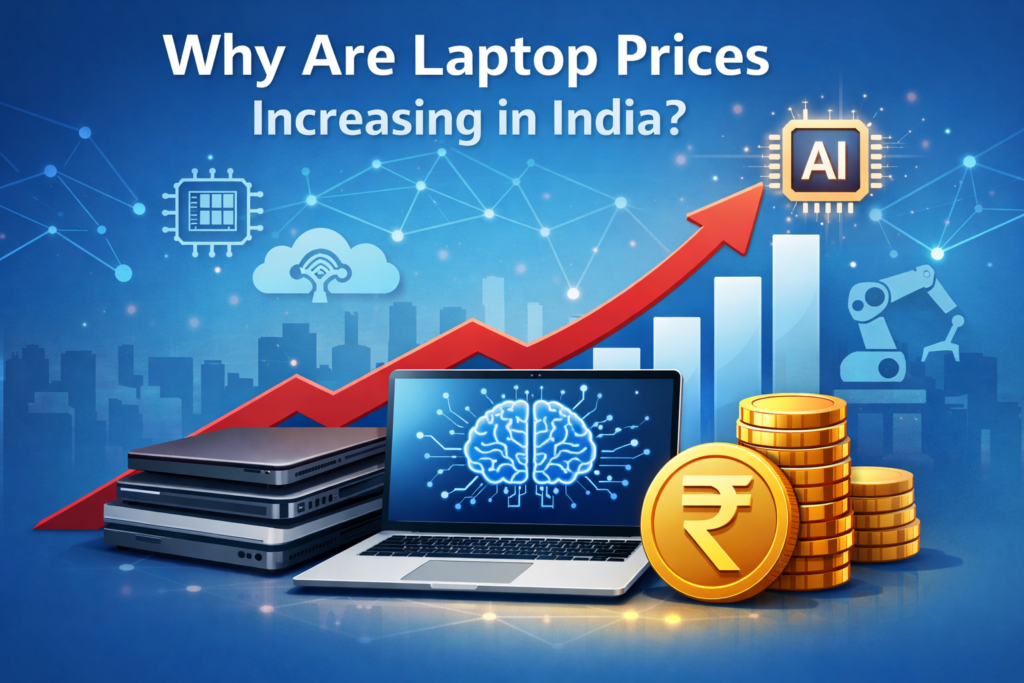
And this time, it’s not just general inflation. The real reason is the global AI boom. Artificial Intelligence is driving unprecedented demand for high-performance hardware, from advanced GPUs and processors to massive RAM and enterprise-level storage.
Even consumers in India are now feeling the impact, as base specifications rise and prices climb slightly higher than before.
This article explains why laptop prices are increasing in India, what’s driving the cost surge, and practical tips for buyers to make smart decisions in this new AI-driven era.
The Era of Falling Tech Prices
For nearly 15–20 years, consumers benefited from what experts call the “declining cost of computing.”
Thanks to improvements in semiconductor efficiency and global supply chains, laptops became:
-
Faster
-
Lighter
-
More powerful
-
Often more affordable
Moore’s Law helped drive this trend, where chip performance improved consistently while the cost per unit of performance dropped.
But AI is now disrupting that long-standing pattern.
What Does AI Have to Do With Laptop Prices?
Artificial Intelligence is everywhere right now — chatbots, automation tools, AI search, image generation, coding assistants.
But behind all of this is something most consumers don’t see:
Massive computing power.
Training and running AI systems requires:
-
High-performance GPUs
-
Advanced processors
-
Large memory capacity
-
Fast enterprise-grade storage
This demand is not coming from regular consumers. It’s coming from large technology companies building AI infrastructure.
For example, companies like NVIDIA are seeing record demand for NVIDIA AI-focused GPUs. These chips are no longer just for gamers — they now power AI models, automation platforms, and cloud services worldwide.
Data Centers Are Buying Hardware in Bulk
Cloud giants such as:
-
Amazon Web Services
-
Microsoft Azure
are aggressively expanding data centers to support AI growth.
And when they buy hardware, they don’t buy in small quantities. They purchase thousands of GPUs, massive RAM modules, and enterprise SSDs at once.
Naturally, manufacturers prioritize these bulk enterprise orders because they generate higher revenue and long-term contracts.
The result?
Tighter supply for consumer laptop manufacturers.
And when supply tightens, prices gradually increase.
Why RAM and SSD Prices Are Rising
AI servers often use 128GB, 256GB, or even higher memory configurations.
When memory manufacturers receive large enterprise orders, production focus shifts toward high-margin server components.
This doesn’t necessarily mean there is a shortage in India. It simply means production priorities have changed.
And when supply is more constrained at the consumer level, prices slowly move upward.
Why Laptop Prices Are Increasing in India: AI and Semiconductor Impact
Advanced chips cannot be produced overnight.
Only a few companies globally can manufacture cutting-edge semiconductors. One of the most important among them is Taiwan Semiconductor Manufacturing Company (TSMC).
Building a new semiconductor fabrication plant:
-
Costs billions of dollars
-
Takes several years
-
Cannot scale instantly
When AI demand suddenly spikes, production cannot immediately match it.
When demand exceeds supply, prices naturally rise. That’s basic market economics.
The Rise of “AI Laptops”
Another subtle shift is happening in the consumer market.
Laptop brands are now marketing devices as:
-
AI PCs
-
AI-enabled laptops
These usually include:
-
Latest-generation processors
-
16GB RAM as the new base configuration
-
Built-in AI acceleration features
A few years ago, 8GB RAM was standard. Now, 16GB is becoming the new normal.
So while prices look higher, the base performance level has also moved up.
In simple terms, consumers are not just paying more — they are buying more powerful entry-level machines than before.
Impact on Indian Consumers
India is a price-sensitive market.
A ₹3,000–₹5,000 increase can influence buying decisions, especially for:
-
Students preparing for competitive exams
-
Engineering and coding learners
-
Middle-class families
-
Small businesses and startups
Higher laptop prices may lead to:
-
Delayed upgrades
-
Choosing lower configurations
-
Increased dependence on cloud services
Since India imports a significant share of semiconductor components, global price increases combined with currency fluctuations can amplify the effect domestically.
Is This a Temporary Phase?
It does not appear to be a short-term spike.
AI adoption is expanding across industries:
-
Healthcare
-
Banking
-
Manufacturing
-
Education
-
Agriculture
As long as AI continues growing, demand for high-performance chips and memory will remain strong.
New semiconductor plants are being developed globally, but price stabilization may take time.
Premium laptops are likely to remain premium.
What Should Indian Buyers Do?
Here are some practical tips:
Don’t buy a laptop just because it says “AI”
16GB RAM is ideal for future-proofing
Previous-generation processors may offer better value
Look for festive sale discounts
Upgrade RAM if possible instead of replacing the entire laptop
Not everyone needs an AI-optimized machine.
Understanding your actual requirements is more important than following trends.
What This Means for India
Why are laptop prices increasing in India? Laptop prices are not rising because companies suddenly decided to charge more. They are increasing because the global technology ecosystem is going through a structural transformation.
The AI revolution is fundamentally reshaping hardware demand worldwide.
Data centers are absorbing advanced GPUs and high-end memory. Semiconductor manufacturing capacity is operating near its limits. At the same time, the base standard of computing performance is rising — with 16GB RAM and AI-ready processors becoming the new normal.
In the short term, Indian consumers may have to pay slightly higher prices for laptops and high-performance devices.
But the long-term story may be more positive.
India is actively investing in semiconductor manufacturing initiatives under its broader digital and industrial development plans. If domestic chip production expands over the next decade, it could reduce reliance on imports, stabilize pricing, and strengthen the country’s position in the global technology supply chain.
Local AI hardware manufacturing could also create:
-
High-skilled engineering jobs
-
Advanced research opportunities
-
Stronger electronics exports
-
A more resilient digital economy
The current phase may feel expensive for buyers. However, it may also represent a transition period — one that lays the foundation for a more powerful and self-reliant digital ecosystem in India.
Today’s higher laptop prices are not just a temporary market fluctuation.
They are a signal that the AI era has truly begun — and the world’s computing infrastructure is being rebuilt to support the next generation of innovation.
Also Read – India’s Biggest Data Centre IPO? Sify Infinity IPO ₹3,700 Crore Issue Could Launch Next Month
Also Read – Anthropic CEO Dario Amodei Warns India -AI Tsunami 2026: Will 50% of Jobs Disappear?
Also Read – Gold and Stocks Surge in 2026 — Kiyosaki Says It’s a Warning for Global Markets